


Verdict: Engwe Engine Pro 2.0
Our editorial rating is based on product testing.
- high-quality workmanship and a great design
- maximum power of 1200 W with a speed of 45 km/h
- high ride comfort thanks to a well-functioning suspension and wide tires
- height-adjustable handlebars and seat
- hydraulic disc brakes
- a lot of visible cables that could have been hidden in the frame
- higher weight and less practical folding
- weaker lighting
The Chinese brand Engwe has only recently launched its latest model, the successor to a very popular one—Engwe Engine Pro 2.0. Compared to the first model, it offers a better battery and a torque sensor.
In our detailed review, we’ll look at how the mentioned torque sensor works, how the range has improved, but we’ll also examine build quality, riding comfort, and introduce all the components and their features.
Where to buy the Engwe Engine Pro 2.0?
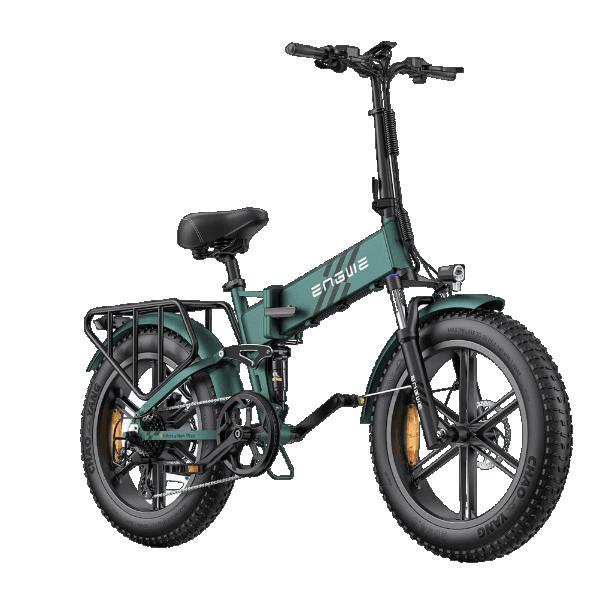
You’ll find the Engwe Engine Pro 2nd generation at the best price from the Banggood seller. The bike is delivered by the courier company completely free of charge, with no need to pay extra fees in the form of clo or VAT. Delivery takes place from a European warehouse in 3-10 days. You can choose from 3 colors — mountain green, space black, midnight blue.
Engwe Engine Pro 2.0
 EU warehouse


TIPExpress delivery from a European warehouse without customs duty and VAT.
This product will be delivered to you express from a local warehouse in Europe. Delivery from EU warehouses usually takes 2–10 days and is handled by a courier. When delivered, you don’t pay any extra fees—no customs duty or VAT.
Technical specifications
| Model | Engwe Engine Pro 2.0 |
|---|---|
| Weight | 31.6 kg |
| Material | aluminum alloy frame 6061 |
| Torque | 75 Nm |
| Motor power | 750 W (1200 W in peak) |
| Sensor | torque sensor |
| Max speed | 25 km/h (set at the factory with the option to increase it) |
| Brakes | hydraulic (160 mm disc) |
| Rear derailleur | 8-speed Shimano Altus |
| Display | LCD |
| Battery | 52 V 16 Ah (832 Wh) |
| Range | 110 km in mode 1 |
| Tires | 20 x 4" |
| Maximum climbing angle | 10° |
| Charging | 5.5 h |
| Suspension | front and rear |
Quality and package contents
The electric fat bike Engwe Engine Pro 2.0 was delivered to us by DPD courier in a large box measuring 144 x 32 x 72 cm, with a total weight of 39.8 kg. The box is made of thick cardboard, joined with metal staples, and secured with plastic straps. In our case, there was only one strap, but the box arrived without any visible damage.


Since the Engwe Engine Pro 2.0 has a folding design, it arrived in the box in folded form, but with the front wheel removed and several components disassembled. Everything is nicely reinforced with polystyrene and tied down with Velcro straps, so nothing rattles around in the box.

We rate the packaging quality as excellent. Besides the bike itself and its components, the box contains only a set of keys, a screwdriver, a charger, and the user manual. The manufacturer didn’t include any extra bonuses.
Unboxing and a fairly lengthy assembly
As we mentioned, the bike is packed in the box in a folded state, but several of its components are disassembled. Assembly isn’t complicated, but it is quite time-consuming. Some screws and nuts are in less accessible spots, and several of the fasteners are tightened rather hard. The manufacturer uses thread-locking adhesive and self-locking nuts with a rubber band, which are tightened more difficultly.

It also takes some time to remove all the packaging material and the elastic straps, of which there really are a lot.
In addition to the front wheel mentioned above, we also need to install both fenders, the front and rear lights, the stem with the handlebar post, the handlebars, the pedals, the rear rack, and the seat.

Especially installing the fenders and the rear rack together with the lights took the most time. That’s where the nuts and screws are located in less accessible places, which drags out the whole assembly—mainly when you use the included Allen keys and open-end wrenches. With your own tools, or an electric impact driver, it goes noticeably faster.
Design and build quality
We had the Engwe Engine Pro 2.0 available for testing in a beautiful green color. Besides that, you can also choose blue and black. The whole fat bike feels very high-quality and heavy-duty. The frame is made from an aluminum alloy 6061 and the overall build quality is at a good level. It’s definitely one of the better-made Chinese bikes.

Its total weight is as much as 31.6 kg, so it’s definitely neither light nor small. It does have a folding design, but even then it’s not easy to carry, especially because in the folded position it doesn’t hold that position well and constantly tends to unfold.

The fatbike has height-adjustable handlebars in the range of 120 – 130 cm, as well as a height-adjustable seat up to 86 – 102 cm. The total bike length including the wheels is 170 cm.
We’ll go through each component step by step, separately.
Handlebars and a clear display
In this case, the handlebars are 62 cm wide, with rubber molded grips and several other components. On the left side you’ll find the brake lever that controls the front brake, together with the throttle lever and a control unit.

On it, you’ll find buttons for switching between riding modes, turning the lights on or off, switching between displayed values (trip from power-on, total trip, maximum and average speed), and turning the bike on or off. These control buttons are also something we’ve seen on other Engwe bikes.

On the right side of the handlebars, there’s only the brake lever for the rear brake, plus Shimano Altus shifting with 8 speeds. In the middle of the handlebars you’ll find a fairly large display.

The dominant data the display shows is the current speed and the selected riding mode. You’ll also find a battery icon with five segments that represent the battery capacity, along with information about the trip as well as average and maximum speed.
It’s a shame there’s no information here about the battery’s current voltage. That would be much more useful to us than the maximum or average speed. The display slightly reflects light and you can see sun glare, but the data are still easy to read.
Riding modes, power, and the new torque sensor
Let’s move on to the most interesting part: the performance and riding experience on the fat bike itself. The Engwe Engine Pro 2.0 offers 5 assisted modes, stepped according to how much help you get when pedaling, plus a standard mode for riding without the electric drive.

In this case, the motor is located in the rear wheel hub and has a nominal power of 750 W. In peak it can reach up to 1200 W. The maximum speed is set by the manufacturer to 25 km/h, and the throttle lever is disabled so the bike meets strict European standards.
But we can increase the speed using a hidden menu, which we’ll discuss in the next chapter. You can also activate the throttle lever using a known trick.

We personally tried the fat bike first with the settings it arrived with from the factory. In this configuration, acceleration is average, and the top speed of 25 km/h feels more relaxed—ideal for getting around within the city.

You’ll like the torque sensor, which tries to keep your ride smooth using pedaling. Unlike many other Chinese e-bikes, with the Engwe Engine Pro 2.0 you can ride just by pedaling nicely without the bike automatically launching to the maximum speed of the selected mode. With several other Chinese bikes, we often had to spin the pedals completely in the air, while the motor was still holding the mode’s maximum speed.

That’s not the case here, so riding this e-bike feels like real biking with the help of an electric motor. But don’t worry—the motor provides enough power to make the ride comfortable and with no significant strain, especially in the highest mode.
Hidden menu and activating throttle control
By holding the + and – buttons for about two seconds, we enter the hidden menu called P-settings. Here you’ll find several settings, including a maximum speed limit marked under number 08. You can set any value up to 99 (the default is 25), and in real testing we reached a top speed of 45 km/h on a flat road.

If someone wants to use a bicycle in a similar way to a moped—meaning controlling speed using only a throttle lever without pedaling—this option is also available. However, it’s not any hidden-menu setting.

The manufacturer doesn’t even mention this option in the manual. You activate the throttle by holding 10-seconds of the left brake lever, the throttle lever, and the on/off button. You must do this with the display turned off, because while you hold those controls, the display turns on and shows an error code 5. To disable it, simply repeat the same procedure again.

After activating the throttle, the bike starts immediately after you press it, so the so-called start from zero is active. In this case, the bike doesn’t distinguish which of the modes you’ve turned on, except for mode zero, since it’s a mode without an electric motor. In all the other modes it’s the same, but what’s odd is that it reaches a maximum of only 32 km/h. As we mentioned above, in the assisted mode we were also able to reach up to 45 km/h.
Brakes, wheels, and suspension
In the Engwe Engine Pro 2.0 you’ll also find hydraulic disc brakes with 160 mm rotors. As for their braking performance, it’s quite solid and basically we have no major complaints about them. We did have to adjust them slightly after assembling the bike for the first time so the brake pads wouldn’t rub against the rotor, but it wasn’t anything difficult.

Up front on the electric fat bike you get a standard suspension fork with about 8 cm of travel, and you’ll also be pleased with the rear suspension, where there’s a shock absorber that’s definitely not bad. Overall, the suspension is very good and the ride on the bike is truly comfortable. Of course, the wide and large 20 x 4″ wheels with a maximum pressure of 20 PSI also contribute, but it’s mainly the suspension doing the work.

We tested the bike also on dirt roads and forest paths, and it handles them completely without any problems—riding off-road like this is also very comfortable. For us, it was probably on dirt paths that it felt the best.
Weaker lighting and a lot of cables
The front light is mounted with a screw together with the front fender, but it’s just a regular light with an additional reflector—it doesn’t shine particularly strongly. This fat bike would definitely deserve a more powerful light with wider beam spread.

The rear and brake light combined is mounted at the end of the rear rack, which also has a load capacity of 25 kg. The light is sufficient and fairly wide.

One of the few things we don’t like about this bike is the number of cables routed along the frame. A rather thick bundle of cables also runs directly through the battery lock on the underside of the frame, where you insert the key, which is very impractical. The manufacturer could have routed these cables inside the frame instead.
Range on a single charge
Compared to the first model, the Engwe Engine Pro 2.0 has a better battery—specifically 52 V / 16 Ah / 835 Wh. Since we moved from a 48 V system in the Engwe Engine Pro to a 52 V system on the new model, the range should improve slightly as well. The battery is removable, so it can also be charged outside the bike.

The manufacturer states a range of up to 110 km, but only in the weakest assist mode with the number 1. Personally, we tried to get the most out of it, so we used it exclusively in the highest mode with the maximum speed unlocked, where it reaches a maximum of 45 km/h. We assume most customers who buy this bike will use it roughly the same way.

After fully charging, we set off for a ride through the surrounding villages near Košice and tracked the range via the Runkeeper app. Since the area around Košice is fairly hilly, we didn’t skip the hills either, and during our ride we tackled several of them with different gradients. A large part of the route also consisted of forest and field paths, while the rest we rode on roads.

Overall, on a single charge we covered about 41.77 km according to the Runkeeper app, although we had the bike out for photos beforehand and during that time we rode only around 1 km. So overall we got roughly 43 km on one charge, while the bike’s display showed 43.8 km, which is quite accurate.


We stopped riding when the last battery indicator had been on for quite some time. Depending on the different available modes and the varying maximum speed, the range depends significantly on your riding style. Several reviews also mention a longer range of around 55 – 60 km.
Engwe Engine Pro 2.0: Final assessment
We clearly enjoyed testing the electric fatbike Engwe Engine Pro 2.0. It’s a folding bike with a maximum power of 1200 W, a high-quality and sturdy frame, plus excellent suspension.

In the green color we tested, it also stands out at first glance with its attractive look. Thanks to the wide tires and good suspension, riding it is very comfortable. A clear color display is also a plus, and you’ll also find the rear rack useful. On a single charge, you can expect at least around 43 km of range, or significantly more if you ride more carefully.
The downside is the higher weight and that the battery status is shown only with a battery icon with segments. We’d much rather have information about the current voltage.
Don’t miss the best coupons 📩
Subscribe and we’ll email you new coupons before they expire. We only send it once a month — no spam.


