


RATING: ANGWATT CS1
Our editorial rating is based on product testing.
- In most cases, the 1000 W power is more than enough
- Decent range
- Solid, durable build
- Nice design
- Competitive price
- Higher weight
- Squeaking from the frame
- Plastic display is hard to read in direct sunlight
- Inaccurate distance measurement
- Sudden battery drain below 50% on more demanding, steep terrain
- Weaker brakes
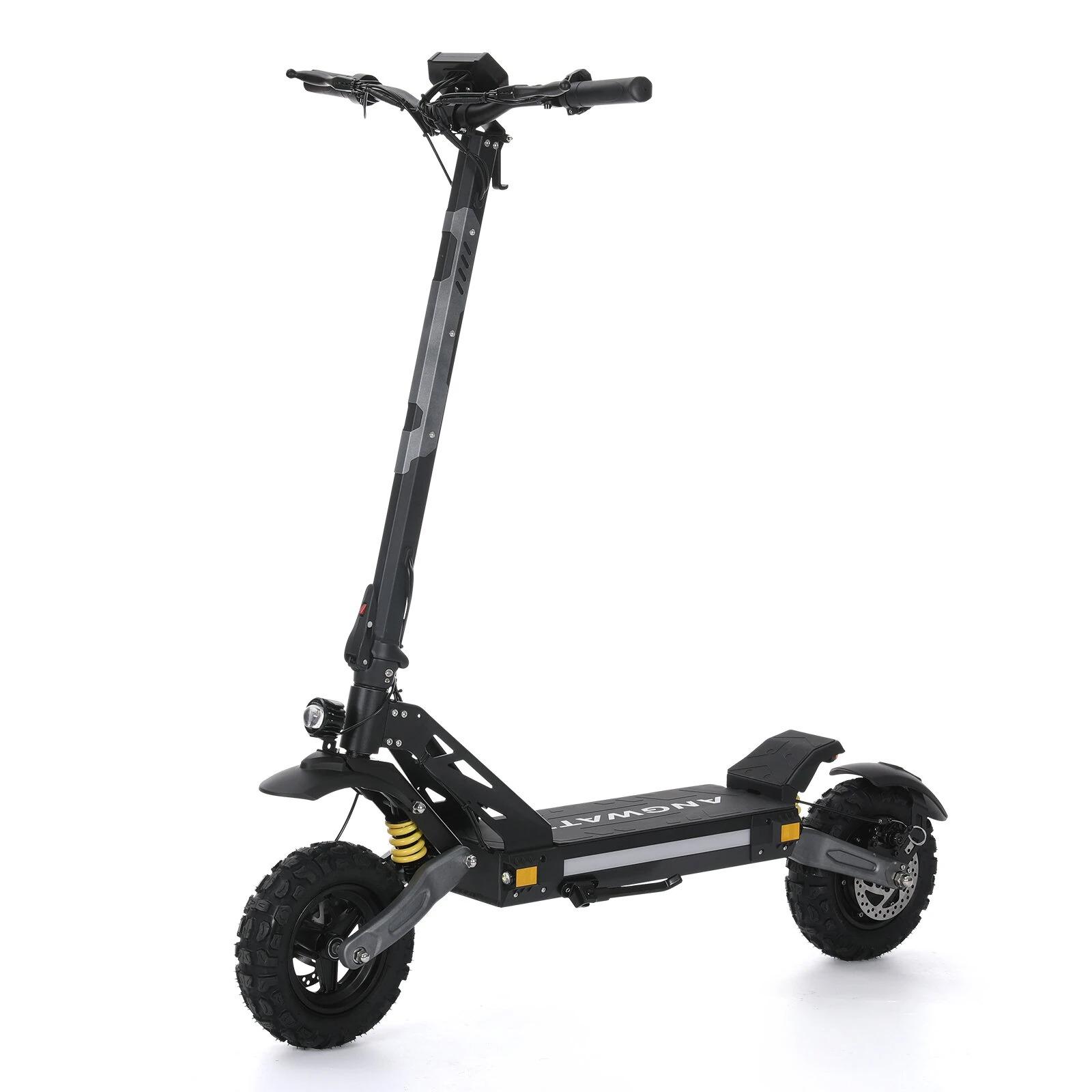
That’s it—at the end of summer, we’re still bringing you a review of the electric scooter ANGWATT CS1. Its main advantage is the lower price, a robust build, and for many people performance that’s more than sufficient at the 1000 W level. The paper specs look very promising; the range of 85 km sounds remarkably good as well. Is everything as great as it seems for the price, even in real life? This is the review of the ANGWATT CS1.
Where to buy the ANGWATT CS1?
You can find the electric scooter Angwatt CS1 in our partner Banggood.com’s offer. You can also use our handy coupon—Allowance discount—and you’ll also be happy with fast shipping up to 5 days, from the Czech warehouse.
Angwatt CS1
 CZ warehouse

TIPExpress delivery from the Czech warehouse with no customs duties and VAT.
This product will be delivered to you express from the local Czech warehouse. Delivery from Czechia usually takes 7-10 days and is handled by courier. On delivery, you don’t pay any additional fees—no customs duty and no VAT.
Quality and package contents
The box the scooter arrived in is very large and heavy. Transport by a standard elevator for three people was possible, but you probably won’t manage it alone. Call someone strong to help you. With the assistance of a second person, the transfer is possible. The box dimensions are 135 x 63 x 25 cm and, according to the manufacturer, its weight is 34 kg. However, the box that was delivered to us has a label showing up to 36 kg. Inside the box, you’ll find the folded scooter. It features a folding mechanism where the latch/lock is located in the front, above the front fender. It’s marked with a yellow warning. There’s also a hook for hanging the front handlebar stem for easier carrying.

You’ll need to install the handlebars additionally. The manufacturer removed them before packaging to save space and to prevent damage during transport. However, the installation is simple. Just insert the handlebar stem into the main vertical stem, then tighten the required screws. The front light was removed as well. The tools needed for assembly are included in the package.

The scooter sits in polystyrene reinforcements. Even so, we did notice small scratches on the frame that may have been caused during transport or during production/assembly. Of course, they don’t affect functionality.

Assembling the scooter took us some time. We spent quite a while figuring out how to screw in the front light, because the relevant thread on the front fender wasn’t fully drilled through, and we had to solve it quickly using our own drill. All components located on the handlebars were loosened, but intentionally so you could adjust their tilt to suit you. The scooter weighs 30 kg and has a load capacity up to 200 kg.
Construction, build quality, design, and lighting
At first glance, the ANGWATT CS1 looks like a very well-built, solid e-scooter. It’s made from an aluminum alloy and doesn’t lack several plastic parts to reduce weight and manufacturing costs. The scooter can carry up to 200 kg in total. The lower price of the e-scooter is noticeable through a slight rattling/creaking in the frame and suspension when you step onto the scooter or while riding over bumpy terrain. It’s a quiet, crackling sound you’ll have to get used to. However, the ride feel isn’t significantly affected. Otherwise, the scooter is firm, durable, and robust.

Looks really nice, especially after turning the lights on. The sides, the rear, and the front are illuminated. The light at the back also works as a turn signal / brake light. The front light is quite strong, but not very efficient, and if you want to ride your e-scooter at night in complete darkness, we’d probably get a better one and mount it on the handlebars. We also have some reservations about the turn signals themselves – we doubt that car drivers will notice them at all on the underside in the rear part of the e-scooter. They’re very small and a bit inconspicuous. They’re activated with a sliding button on the left side of the handlebars.

The buttons on the aforementioned control unit are used to switch between “gears”, of which there are five and they indicate performance levels. Further on, you’ll find a button to activate the lights, a button for the sound signal, which is quite loud, and a “Drive Transfer Switch” button that activates the dual-motor mode. Since ANGWATT CS1 has only one motor, this control does nothing and its presence is pointless. We also mustn’t forget the power button. To activate the scooter, you need to press it and hold a NFC card against the display. You get two of them in the package.

Registration sometimes happens right away, other times you need to move the chip across the screen for several seconds to successfully “boot up” the scooter. Once the scooter is active, pressing the power button again won’t turn it off; it will simply show the total number of kilometers ridden on the display instead of the number of kilometers from the last start. To turn it off, you have to apply the card again to the LCD panel. If you leave the scooter powered on for a long time with no activity, it will turn itself off.
Performance and riding characteristics
The 1000 W motor is more than enough for many people. It’s a front drive that, according to the manufacturer, allows a maximum speed of up to 55 km/h. We tested the scooter in Poprad and the surrounding area, so there was no shortage of hilly terrain. On the flat, the ANGWATT CS1 reached the stated 47 – 55 km/h. The highest speed, 55 km/h, was achieved while riding downhill; otherwise expect 45 – 50 km/h, depending on the battery charge level. Acceleration in the highest performance mode is quite lively.

Tubeless tires are 11 inches and have a chunky tread, which also makes them suitable for off-road use. A slight incline doesn’t bother the scooter, but steep hills it handles only with assistance — by pushing off with your foot. A very steep hill can’t be managed at all, and you’ll have to push the vehicle up to the top. Gravel terrain can also be challenging for the scooter in certain cases. On flat ground, it’s great — the suspension is very good and vibrations are reduced enough, but even a mild incline over larger stones can cause problems at the 1000 W output and the ride will be noticeably slower. After lighter gravel, the ANGWATT CS1 goes through quite nicely and smoothly.

The scooter is easy to control — you can smoothly change direction with the handlebars, and there’s enough room to stand, both in length and width. There’s a rear footrest. The brakes are a bit weaker and the ANGWATT CS1 has a fairly long braking distance, especially if you want to brake from high speed.

For riding this e-scooter, you need good anticipation skills and you must react to obstacles in time so you can brake properly. Of course, there’s a front and a rear brake. During braking, the rear light turns on—it also works as a classic night light and as a turn signal. There are five performance modes that adjust the level of acceleration and also the maximum speed. In general, each performance level increases the maximum speed by approximately 10 km/h.
Range & charging
ANGWATT CS1 doesn’t show the battery’s percentage level—only five battery bars. That’s why we had to estimate, based on multiple rides and the experience we gained while testing this model, roughly how many percent we used on a given route. We tested the scooter’s range on several paths. Our most common test route was the Poprad – Svit cycle path.

This overall 17 km route, which is fairly flat (there and back), includes about 40 m of elevation gain on the way to Svit and then 40 m of descent on the return trip. We intentionally didn’t ride fast all the time to simulate an easy, city-style ride, with an average speed of 25 km/h and occasional stops. At the end of the outing from a fully charged battery, not even one bar was gone. We estimate we used 15% of the battery.

We covered the Poprad – Kvetnica loop, which measured 11.86 km and included a 100-meter climb, at an average speed of 21.3 km/h. Going downhill, we managed to reach a top speed of 53 km/h. A small part of the route was gravel, and the terrain had several steeper climbs. From the battery charge again, we used roughly 15%.


At the start of the ride on the concrete path to Lopušná Valley, our battery was fully charged. After the 10 km route with a small, negligible elevation gain, one bar disappeared. The entire route had 228 m of elevation gain, and on two steep hills we had to push the e-scooter because it couldn’t handle them. After completing the full 25 km route, a second bar disappeared from the battery indicator. Even though there were theoretically still 3/5 of the battery left, we wouldn’t have been able to make this route a second time on a single charge.

When the battery level drops below 50%, the indicator is no longer reliable, and on routes with elevation changes, expect a sharp drop in power. The next day we wanted to ride this section again. After the first 10 km, one bar disappeared, and when the first steep hill came, another one did too. As soon as we stopped, the icon again showed 2/5 of the available capacity. We decided not to ride to Lopušná Valley again because we were worried that the e-scooter might shut off halfway through the route. Our concerns were justified.

While continuing the uphill ride and about 5 km on flat ground, the display instead of the current speed started showing the message “E5” and the battery indicator began to blink. We immediately knew that the end of the ride was approaching. After 1.5 km of riding from the first signs of running out of battery, the e-scooter switched to turtle mode – the speed was limited to 5 – 10 km/h. It’s a small assistance feature that helps you when pushing the e-scooter, and we were also able to ride down the hill and then home to the housing estate, where we charged the e-scooter. Somewhere in the middle of the cycle path, the e-scooter turned off completely and we pushed it home.

On demanding routes where you’ll use the ANGWATT CS1 at full power, you can expect a range of from 35 to 40 km. On flat roads at lower speeds—e.g., for city riding—based on our experience you’re looking at a realistic 50 km. We also factor in the fact that the e-scooter usually runs out a bit faster when you’re below half capacity. Luckily, this sudden charging difference is less noticeable on flat stretches.

During our testing, it was always sunny and calm, or there was only a light breeze, and the temperature during that period ranged from 24 – 28 degrees Celsius. The e-scooter is powered by a 48 V lithium battery with a capacity of 21.3 Ah. Charging from empty to full takes 10 hours, which is 2 hours longer than the 8 hours stated by the manufacturer. The charger output is 54.6 V / 2.5 A, which—after a simple calculation—gives an output power of 136.5 W. The manufacturer states that the maximum output is 140 W. The charging connector is protected by a rubber cap. That cap often opens on its own.
Display
The LCD display isn’t made of glass, but of plastic. Right after unpacking, there were scratches on it that reduce its visibility, which is already poor due to the low brightness. In direct sunlight, the screen is almost unreadable, but at this price range we don’t consider that too tragic. While riding, you probably won’t be looking at the display much anyway—and if anything, you’ll mainly care about the speed you’re going.

To read the other information the display shows, you’ll probably need to stop and shield the LCD with your hand. You’ll see the battery charge indicator (a battery icon with five bars, the battery voltage, the selected gear (performance level 1 – 5), and other indicators such as icons for lights and turn signals, or error messages—their descriptions are in the user manual (which, by the way, is entirely in English).

To wrap up, we’ll mention that the mileage indicator shows an offset of about 1 – 1.5 km for every 10 km, which is quite a lot. For our tests, we followed measurements taken with Apple Watch Ultra smartwatches (cycling mode).
ANGWATT CS1: Final assessment
ANGWATT CS1 is mainly for people who live in areas with mostly flat surroundings. It can handle elevation changes in the city, but it isn’t designed for longer, more demanding routes full of hills. The ride is very comfortable, thanks to the great suspension, large tires, and overall robust construction, which gives you plenty of room to stand while riding. The range is fairly decent, even though it’s lower than what the manufacturer claims. Still, you could have expected that.

The brakes are a bit weaker, the display is almost unreadable outdoors, and scratches that appear quickly on it don’t help either. The build creaks a little when mounting it or when riding over bumpier terrain. Performance on flat roads is very decent on its own, and acceleration is lively for the price. If you’re looking for an e-scooter for the city, for the bike path, or even for riding on gravel—and you don’t want to spend a lot of money—buying the model ANGWATT CS1 is definitely not a bad decision. Its downsides are offset by the price, which is why our recommendation stands.
Angwatt CS1
CZ warehouseTIPExpress delivery from the Czech warehouse with no customs duties and VAT.
This product will be delivered to you express from the local Czech warehouse. Delivery from Czechia usually takes 7-10 days and is handled by courier. On delivery, you don’t pay any additional fees—no customs duty and no VAT.
Follow the China Planet website, sign up for push notifications, and definitely check our Facebook page, the Everything from EU warehouses group, and subscribe to our Telegram, where we add the best deals and coupons from China day after day.
Don’t miss the best coupons 📩
Subscribe and we’ll email you new coupons before they expire. We only send it once a month — no spam.


