


Verdict: Xiaomi 13
Our editorial rating is based on product testing.
- new design without rounded display edges
- powerful Snapdragon 8 Gen 2 from Qualcomm
- fast UFS 4.0 storage
- the ability to uninstall many system apps
- text recognition right in the camera app
- so far only the Chinese version without B20 LTE
- weaker wide-angle camera
- the glossy finish on the back cover is prone to fingerprints
Xiaomi managed to unveil the first model of its new flagship series with the 13 numbering toward the end of 2022. Xiaomi 13 is still a hot new release, but once again we’re among the first in Slovakia and the Czech Republic to bring you an in-depth review.
We’ll focus mainly on the changes the new model brings compared to its predecessor, but we won’t forget the traditional categories either, including a camera test.
Where to buy Xiaomi 13?
At the time of writing, the new Xiaomi 13 model was available only in the Chinese version, since the global one hadn’t been announced yet. We ordered the smartphone from the international store TradingShenzhen, which delivered the phone to us without any extra customs fees—and extremely fast, too. Delivery from China took just 9 days!
If you want to order Xiaomi 13, keep in mind that the Chinese version comes without support for the 4G band B20. Also, only Chinese and English are available in the system—something Xiaomi will fix later with the Xiaomi.EU ROM.
Xiaomi 13 Chinese Version (without B20 LTE)

TIPWith Global Priority shipping, you don’t pay any additional fees.
We recommend choosing Global Priority shipping, where you won’t have to pay anything extra. Customs fees and any VAT will be handled by the seller directly for you. Shipping can be selected in the cart after you enter your delivery address. Delivery with Global Priority usually takes about 15 days, but it may also take longer.
TIPWith Global Priority shipping, you don’t pay any additional fees.
We recommend choosing Global Priority shipping, where you won’t have to pay anything extra. Customs fees and any VAT will be handled by the seller directly for you. Shipping can be selected in the cart after you enter your delivery address. Delivery with Global Priority usually takes about 15 days, but it may also take longer.
Technical specifications
Model designation Xiaomi 13 Dimensions 152.8 x 71.5 x 7.98 mm Weight 189 g Processor Qualcomm Snapdragon 8 Gen 2 RAM 12 GB LPDDR5X Storage 512 GB UFS 4.0 Battery 4 500 mAh Charging 67 W wired / 50 W wireless / 10 W reverse wireless Operating system Android 13 with MIUI 14 overlay Display 6.36" OLED resolution 2400 x 1080 px max brightness 1 900 nits dynamic refresh rate – up to 120 Hz sampling rate 240 Hz HDR10+ and Dolby Vision Dual SIM yes – 2 x nano SIM Cameras main 54 MPx with f/1.8 aperture and OIS ultra-wide 12 MPx with f/2.2 aperture telephoto 10 MPx with f/2.0 aperture selfie 32 MPx with f/2.0 aperture Sensors accelerometer; 2 x light sensor; proximity sensor; e-compass; gyroscope; IR Location systems GPS; GLONASS; GALILEO; BeiDou; NavIC; A-GNSS WiFi Wi‑Fi 6e | 2 x 2 MIMO | 8 x 8 MIMU | WiFi Direct Bluetooth 5.3 NFC yes
Package contents
In the box, you won’t find anything unusual—instead, it has exactly what you’d expect. In the white cardboard box you get, besides the phone itself, a charging cable, an adapter (in this case with a Chinese plug), a SIM ejector pin, and a standard clear protective case.

Since we ordered the new model from our favorite partner, TradingShenzhen, the package also included a gift: a pair of Christmas socks and an adapter for European power outlets.

Significant design changes
Xiaomi 13, just like Xiaomi 12, keeps its impressively compact dimensions even by today’s standards—152.8 x 71.5 x 7.98 mm, weighing 189 g. So the smartphone is truly small compared to most phones on the market today, which can be a huge advantage for many people.

At first glance, we were drawn to its completely new design and build—something we’re not used to seeing in Xiaomi’s flagship models. Xiaomi 13 features sharp edges in the style of Apple-branded smartphones, along with a flat display with no rounded edges.

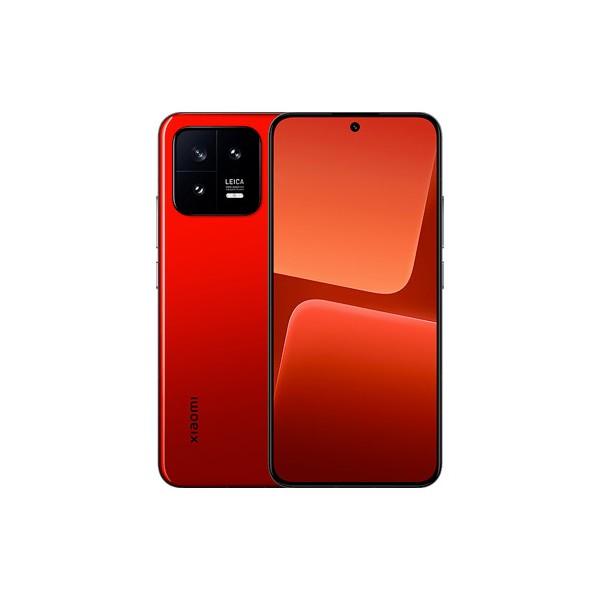
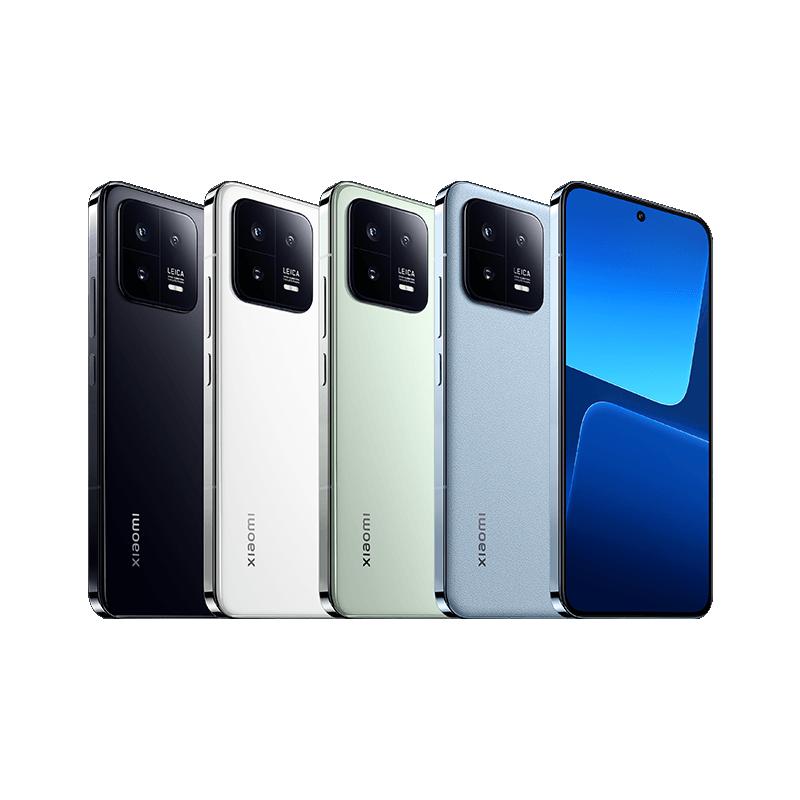
We have the red variant from the limited edition available, which we already informed you about on our sister website XiaomiPlanet.sk. You can choose from five combinations with rich, bold colors. Specifically, it comes in red, green, blue, yellow, and gray. The back cover is glossy and protected by tempered glass.

The smartphone’s design line is also complemented by a glossy black frame, which is only on the back and is very gently rounded for a more comfortable grip in your hands. We have to admit this was a good move—thanks to the subtle rounding, it feels much more comfortable to hold than other phones with sharp edges.

Of course, there’s also the standard version of the smartphone, with a back cover featuring a leather-surface finish, following last year’s model. As for colors, you can choose from understated, classic smartphone shades like white, black, light blue, or green.

The rear camera module has also changed—it’s now square and also slightly resembles the competition. Overall, due to the tempered glass and the vivid color, the back cover is rather prone to fingerprints, which we don’t really like. Most of you, though, will be using the phone in a case—which is standard, but it noticeably mutes the vibrancy of the back cover’s color.
Layout of the controls
As for the layout of the individual control elements, despite the design changes, basically nothing has changed. On the bottom, you’ll find a USB-C charging port along with a microphone, a SIM card slot, and a loudspeaker.


On the top edge there’s another pair of microphones, an infrared sensor, and an unusual small opening for audio output from the second speaker. The left side is traditionally empty, while on the right you get volume control buttons along with the button to turn the smartphone on or off.

Flat OLED display
Xiaomi’s latest release features a 6.36″ OLED display from Samsung with a resolution of 1080 x 2400 px. There’s also the traditionally high refresh rate of 120 Hz, which adjusts depending on your current needs. Automatic refresh rate switching is also set as a preset parameter. The smartphone can switch between 60 / 90 and 120 Hz.

As we already mentioned in the previous chapter, the display isn’t curved—this is how Xiaomi answered many fans who were asking for a flat display. The selfie camera is traditionally placed in a cutout in the center of the top part of the screen.

It also stands out with an exceptionally high brightness of 1200 nits, reaching up to 1900 nits at maximum. So you don’t have to worry about poor visibility in direct sunlight. Xiaomi also states that display power consumption has been reduced by up to 12 % versus the previous Xiaomi 22 model.

You’ll also appreciate HDR 10+ and Dolby Vision support. If we were to evaluate the display overall, it’s undoubtedly among the best on the market.
The fingerprint reader is placed under the display as well, but again—it’s somehow quite low, similar to what we see with the Xiaomi 12T Pro. As for accuracy and reliability, it still lags behind the fingerprint scanners found in flagship models from Vivo and iQOO.
New Snapdragon 8 Gen 2
Even the base model of Xiaomi 13’s flagship series comes with the latest Qualcomm processor, the Snapdragon 8 Gen 2. It’s a 8-core processor built on a 4 nm process. It consists of one super-powerful Cortex-X3 core clocked at 3.2 GHz, four cores clocked at 2.8 GHz (2 x Cortex-A715 and 2 x Cortex-A710), and three Cortex-A510 cores at 2 GHz.

With a processor like this, there’s really no point in focusing on performance. What’s more, we already tested it during our testing of the Vivo X90 Pro Plus. You can play any mobile-platform game here without having to worry about lowering the details.
Our limited-edition smartphone comes with 12 GB of LPDDR5X RAM, with the option to expand it by 3 GB from internal storage. The storage capacity is 512 GB, and it uses the latest UFS 4.0 technology.

Of course, there are also other memory versions—specifically with 8 GB RAM, or with internal storage capacity of 128 or 256 GB.
Even when gaming demanding titles, the phone body only heats up slightly, and temperatures stay within normal ranges—so Xiaomi handled cooling quite well. In AnTuTu, it achieved a score of 1 279 951 points.

We can finally uninstall system apps
With the new model for year 2023, there’s also a new MIUI 14 interface with Android 13. Xiaomi 13, along with the higher 13 Pro model, is the first Xiaomi smartphone to start selling already with the new pre-installed interface.

We already tested MIUI 14 in our editorial Xiaomi MIX 4 thanks to the Xiaomi.eu community, and we also published a review about it. Of course, Xiaomi 13 is available in the Chinese version, since the global version hasn’t been announced yet. That means Slovak and Czech languages are missing in the interface. Also, Xiaomi.eu ROM is not available yet, so we have to make do with English.

As we already mentioned in our MIUI 14 review, there aren’t many design changes to the interface. However, you’ll find a few very interesting updates, and arguably the biggest one is the ability to uninstall many system apps.
Finally, you can uninstall apps that are preinstalled on the smartphone but you don’t use. The new MIUI 14 lets you remove everything except eight apps: Contacts, Camera, Settings, Files, Browser, Phone, Messages, and GetApps. For us, this is probably the best new feature—we highly appreciate it.

But there are also other interesting changes. MIUI 14 brings a lot of new widgets, so-called super icons, and big folders. Super icons are essentially enlarged icons that take up space for 2 to 4 standard icons. It’s the same with large folders.

Automatic text recognition from a photo also deserves attention—it works right inside the camera app. It can recognize text even before the photo is actually taken. If it happens, a square icon with a circle in the middle will appear on the screen. We can copy the recognized text directly and then use it further or edit it. Reliability isn’t 100%, but it’s at a good level.


Xiaomi states that overall system stability, speed, and security have also been improved. The smartphone should process sensitive data locally, without uploading it to the cloud, whenever possible. However, we can’t verify these improvements.
The cameras aren’t exactly top-tier, but they don’t disappoint
Since Xiaomi saves its photographic trump cards for higher models like Xiaomi 13 Pro or Ultra, the base model gets the main 1/1.49″ Sony IMX800 sensor with a resolution of 54 MPx. Unfortunately, the ultra-wide and telephoto cameras don’t have such good specs, but we’ll take a detailed look at their output as well. Leica collaboration is not missing either.

| Main camera | 54 Mpx | Sony IMX800 sensor (1/1.49") | equivalent focal length 23 mm | aperture f/1.8 | OIS |
|---|---|---|---|---|---|
| Ultra-wide-angle camera | 12 Mpx | Omnivision OV13B10 sensor (1-3.06") | equivalent focal length 15 mm | aperture f/2.2 | - |
| Telescopic camera | 10 Mpx | Samsung S5K3K1 sensor (1/3.9") | equivalent focal length 75 mm | aperture f/2.0 | OIS |
Main camera
As expected, the main camera is, of course, the best of the three. It uses the Sony IMX800 sensor, though it isn’t among the largest. It has a size of 1/1.49″, which is still not a bad value. Thanks to the Leica partnership, you again have a choice of two modes: Leica Authentic and Leica Vibrant.


Overall, photos from the main camera are sharp and have a good dynamic range, but their color rendering depends significantly on the selected Leica mode. Vibrant mode delivers noticeably higher brightness and more vivid colors, while in Authentic mode the colors are surprisingly warmer and the photo has higher contrast. For example, even the sky has a hint of yellow in Authentic mode.


For that reason, photos in Authentic mode are often far too dark. The shadows are overly pronounced and the photo doesn’t look quite real, despite expectations. With higher contrast in Authentic and more distinct shadows, you can see more detail—for example on buildings or sidewalks, which are so bright in Vibrant mode that they sometimes disappear.


Generally speaking, the main camera is indeed the best of the three, but it definitely isn’t an absolute top-tier offering on the market. It won’t disappoint you, but it also won’t wow you in any way.


Ultra-wide-angle camera
As has become customary, the main camera deserves the most attention, and the others don’t take away as much. In that spirit, Xiaomi’s engineers likely approached the new product this way, since the ultra-wide camera is very average and noticeably weaker than the main one.


With this camera too, you can choose between Leica’s Authentic and Vibrant modes, but the quality isn’t as good anymore. Wide shots are often darker, with a clearly worse dynamic range. When shooting in direct sunlight, blown highlights or areas that are too dark often show up.


In a dimly lit interior, noise increases and sharpness drops. Overall, the ultra-wide camera doesn’t really surprise you, but in good light you can still make nice shots with it.
Telescopic camera
When using the telephoto camera, you can choose from preset values of 2-x or 3.2-x zoom in the photo app. The telephoto camera may only be 10 Mpx, but it really pleasantly surprised us.


The maximum optical zoom is the mentioned 3.2x, where the shots are surprisingly good. Of course, higher resolution and a larger sensor with higher brightness would do an even better job, but for its specs, this camera is excellent.


It has a good dynamic range, nice color rendering, and despite slight noise and not the best sharpness, the results are decent. Personally, we used this camera the most, probably more than the others.
Night photos
Naturally, there’s also a night mode that activates automatically. We turned off the automatic switch-on for this mode in the settings so we could show you the difference between shots without night mode and with it. The difference isn’t too dramatic, but it is noticeable.


Night mode brings more light and detail into your photos. Photos in Vibrant mode are brighter, and we personally like them more. If we compare the individual cameras, the worst is the ultra-wide camera, which doesn’t have great sharpness.


The best, of course, is the main camera—you can use it to take genuinely great shots even after dark. Unfortunately, it doesn’t handle strong light sources as well, especially when there’s darkness around them, which creates big contrasts right next to each other.
Video
For video, the maximum resolution is again up to 8K, but only at 24 fps and without stabilization. So once again, we mostly used 4K resolution, where stabilization is available and you can choose between 24, 30, or 60 fps.
The following video was recorded using 4K resolution at 60 fps.
The colors in the video are clearly contrasted and vivid, so reality feels a bit distant, but the video looks attractive at first glance. Standard optical stabilization doesn’t work quite perfectly, so during walking you can see shake in the video. Better stabilization unfortunately is available only at 1080p / 30 fps and is labeled Steady video or Steady video Pro.
Battery and charging
Xiaomi 13 hides a compact body with a 4 500 mAh battery. The package includes a 67 W charging adapter with a Chinese plug, but the seller also included a European adapter. There’s no shortage of support for 50 W wireless charging or 10 W reverse wireless charging.

As for battery life, it doesn’t really stand out, but it’s definitely not among the weakest. One day without charging should be achievable with this smartphone without any trouble.
You can check the wired charging progress, 67 W from 20 % to 100 %, in the table below:
capacity time 20 – 50 % 10 minutes and 56 seconds 75 % 21 minutes and 44 seconds 90 % 29 minutes and 1 seconds 100 % 37 minutes and 50 seconds
Charging isn’t among the fastest, but in essence it’s a kind of golden middle ground among Chinese flagship models.
Connectivity and sound
As we already mentioned in the introduction, only the Chinese version of the smartphone is currently available, and unfortunately it lacks support for the most commonly used 4G band here, B20. This is used mainly in villages, so in Košice, where we tested the smartphone, we more or less didn’t even notice it.

Let’s not forget support for 5G networks either. Since Telekom expanded its 5G coverage, we mostly connected to this network. Where 5G wasn’t available, we mainly used the 1800 MHz 4G band labeled B3. So if most of your time is spent in the city, the Chinese version won’t be any obstacle, because it can connect to both 4G and 5G networks.
The smartphone doesn’t lack support for wireless technologies like Bluetooth (version 5.3), WiFi 6, or NFC. Despite being the Chinese version, contactless payments work without any problems. Just install Google Wallet and set this app as the default for payments.

You may have noticed in the photos that the Harman Kardon logo is no longer present on the speaker grille. In addition, there’s only a small opening in the top edge of the smartphone instead of a speaker grille. That doesn’t matter at all, though, because the sound quality is very decent.
Xiaomi 13: Final evaluation
A new base model from the flagship series, Xiaomi 13, follows in the footsteps of its predecessor with a compact smartphone that’s visibly smaller compared to most today’s phones. We tested it in the Chinese, limited edition in a striking red color with a glossy finish.
Once again, we appreciate the beautiful 6.36″ OLED display with thin bezels and extremely high brightness that can go up to 1900 nits. Performance is handled by the new Snapdragon 8 Gen 2, which is top-tier on the market. We also get the new, even faster UFS 4.0 storage.

With the new model, we also got a new MIUI 14, which finally allows you to uninstall system apps you don’t need, with just a few exceptions. The text recognition feature directly in the camera app is also great.
Overall, we grew very fond of the smartphone during testing, especially thanks to its compact dimensions and smooth operation with instant responses and uncompromising performance. Soon, we’ll definitely also get a global version, which will bring Slovak and support for all networks.
Don’t miss the best coupons 📩
Subscribe and we’ll email you new coupons before they expire. We only send it once a month — no spam.


