


Rating
Our editorial rating is based on product testing.
- stunning InfinIty display
- selfie camera hidden under the display
- ultra fast charging
- elegant ceramic body
- higher weight
- no macro lens
Xiaomi’s MIX lineup has always, as a rule, brought something unusual—often staying one step ahead of the competition. After a few years’ break, Xiaomi MIX 4 is finally here, delivering a truly unique display with no notch or punch-hole, and a front camera hidden under the display.
Most of you are probably mainly interested in the photo quality shot with the front camera. In the review, though, we’ll also look at the other features of the smartphone, test its performance and charging speed, and share our experience after everyday use.
Where did we buy the Xiaomi MIX 4?
If you follow our pages regularly, you’ve definitely noticed that we ordered the Xiaomi MIX 4 smartphone already a few days after its presentation by our international partner, TradingShenzhen. They traditionally bring the first opportunity to order even the Chinese versions of smartphones that don’t make it to our market. You can read more about the ordering and delivery itself in our article.
Xiaomi Mi MIX 4 Chinese version (with B20 LTE)

TIPWith Global Priority shipping, you don’t pay any additional fees.
We recommend choosing Global Priority shipping, where you won’t have to pay anything extra. Customs fees and any VAT will be handled by the seller directly for you. Shipping can be selected in the cart after you enter your delivery address. Delivery with Global Priority usually takes about 15 days, but it may also take longer.
TIPWith Global Priority shipping, you don’t pay any additional fees.
We recommend choosing Global Priority shipping, where you won’t have to pay anything extra. Customs fees and any VAT will be handled by the seller directly for you. Shipping can be selected in the cart after you enter your delivery address. Delivery with Global Priority usually takes about 15 days, but it may also take longer.
TIPWith Global Priority shipping, you don’t pay any additional fees.
We recommend choosing Global Priority shipping, where you won’t have to pay anything extra. Customs fees and any VAT will be handled by the seller directly for you. Shipping can be selected in the cart after you enter your delivery address. Delivery with Global Priority usually takes about 15 days, but it may also take longer.
In short about the MIX lineup
Xiaomi first came to the market with the MIX series back in 2016, when we were introduced to the first model of the series with a large display and almost no bezels. It was this series that kicked off the era of shrinking bezels around the display. The only noticeable frame was the bottom one, where the selfie camera was located.
The Mi MIX 2 continued in a similar spirit a year later. It was a bit more compact, but the design stayed true to the original. This model also received an improved version in the form of Mi MIX 2s.

In 2018, Xiaomi introduced the first truly bezel-less smartphone to us—it had an interesting sliding design. Once you slid it out, the front camera appeared. However, the next year brought no new model from this series. After the experimental Mi MIX Alpha, which never reached retail, we finally have a new release now in 2021, when the MIX 4 comes to the market with a front camera under the display.
Technical specifications
Display resolution 2400 x 1080 refresh rate 120 Hz sampling rate 480 Hz contrast 5 000 000:1 Processor Memory Main cameras 13 MP ultra-wide camera with a 120° field of view 8 MP periscope camera / 5x optical zoom / 50x digital zoom / OIS Front camera Connectivity Wi-Fi Battery and charging Dimensions and weight TV boxes Memory variantsXiaomi MIX 4 6.67" CUP 3D AMOLED Qualcomm Snapdragon 888+ / up to 3.0 GHz LPDDR5 6400Mbps + UFS 3.1 storage 108 MP main camera: 1/1.33″ HMX sensor / OIS 20 MP under-display camera (CUP) UWB / NFC / IR Blaster / Bluetooth 5.2 802.11 a/b/g/n/ac/6e 4 500 mAh / 120 W wired charging / 50 W wireless charging 162.65 x 75.35 x 8.02mm / 225 g Harman Kardon stereo speakers 8 GB + 128 GB / 8 GB + 256 GB / 12 GB + 256 GB / 12 GB + 512 GB
Premium packaging
Since this is a premium model, the packaging also matches the same spirit. We received the Xiaomi MIX 4 in a black, flat box measuring 16.2 x 22 x 5.2 cm with gold lettering and the Xiaomi logo.


After opening the box, you’ll find a black cardboard insert with Chinese text that translates to “The world isn’t perfect, but there’s always someone looking for perfection”. Under it, the smartphone itself is already placed in a rigid frame.

Under the smartphone, we also find three small boxes—each one labeled based on what it contains. One holds a classic, transparent case with a USB-C to 3.5mm audio jack adapter; the second contains a charging adapter; and the third includes a USB cable for charging.
Layout of the elements and build quality
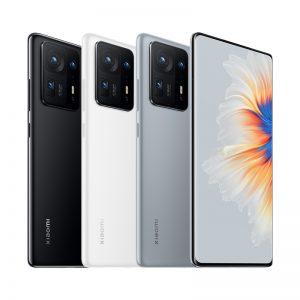
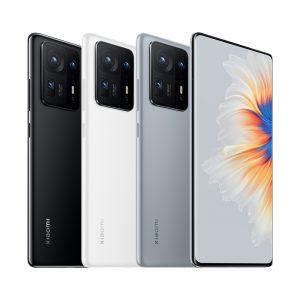
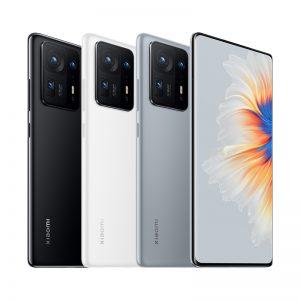
As usual, the latest model in the MIX series comes with a ceramic body. Our tested unit was available in a gray color, which is absolutely stunning. In our opinion, this color variant is one of the most beautiful smartphones Xiaomi has ever made.

Its weight is 225 g, putting it among the heavier smartphones. That’s also due to the large camera module on the back, which sticks out noticeably from the phone. Design-wise, it looks like the camera module from Xiaomi Mi 11 Ultra, only cut down by the secondary display.

In hand, the smartphone feels very comfortable, which is also helped by the rounded edges of the back cover. However, the ceramic part is slightly slippery, so we carried the phone the whole time in the included case. It also protects the rear camera module from scratches that could happen, for example, when sliding the phone across a table.
As for the placement of the individual elements, nothing is unusual here. The left side of the smartphone is completely blank, while the right side has buttons for volume control and also a button to power the smartphone on or off.

The bottom edge hides the charging USB-C connector, a slot for 2 SIM cards, and the main speaker. The second speaker from Harman Kardon is located at the top, together with sensors and a microphone. The speakers sound clean, similar to the Mi 11 and Ultra models, but they’re slightly lacking in bass.


The display is the smartphone’s pride
The most interesting element—and also the biggest draw of this smartphone—is its display. It’s a 6.67″ AMOLED display with a 2400 x 1080 px resolution, 400 ppi pixel density, and support for the P3 color gamut, with an in-display fingerprint reader integrated into it.

The display has a 120 Hz refresh rate, a 480 Hz sampling rate, a contrast ratio of 5 000 00:1, and it’s slightly curved at the sides. It’s protected by the newest layer of Corning Gorilla Glass Victus protective glass.
However, the display is unique thanks to its CUP branding — short for camera under panel. In simple terms, it’s a sort of secondary circular display integrated into the main panel. Under this circular area, there’s the selfie camera, so for the first time we don’t have any notch or cutout that would distract us. A beautiful infinity display with very thin bezels is simply gorgeous.

The mentioned circular panel is a small semi-transparent display made up of different pixels that can reorganize themselves. Their movement allows changing how light flows through the panel up to the lens located underneath it.
When you look at the powered-on display, in the area where the camera sits under the panel you can see absolutely no difference compared to the rest of the screen. The overall impression is, however, slightly spoiled by the film that’s stuck on the display and has a cut-out for the selfie camera. This cut-out is noticeable even when the display is on, but if you removed the film from the display, you wouldn’t even be able to tell where the selfie camera is.

With the smartphone switched off or on a black background, however, the selfie camera is visible. Especially when you look closely and point the smartphone toward the light—the camera under the panel will catch a watchful eye. At first glance it’s really invisible, though, and if you’re one of those who find the cut-out or aperture distracting, you’ll be pleasantly surprised.
Thanks to the high refresh rate, the display is extremely smooth, with beautiful colors, and it ranks among the top-tier. There’s also the popular always-on display with plenty of customization options.
No shortage of powerful hardware.
Power is handled by the upgraded flagship Qualcomm Snapdragon 888+ 5G processor, thanks to which the Chinese version—one we’re testing here—is fully usable with us. It has full support for LTE B20, which is used in Slovakia. The tested memory variant offers 12 GB of LPDDR5 RAM and 256 GB of storage, which is UFS 3.1 type.

Since we’re dealing with top-of-the-line hardware right now, it doesn’t make much sense to get into performance details. This is one of the most powerful smartphones in the world, so the system is exceptionally smooth with zero stutters or lags. You can play anything on it, and thanks to the quality display it will be a true experience.

We also put the Xiaomi MIX 4 through the well-known AnTuTu test, where it scored 797,019, placing it at the very top among all Xiaomi smartphones. The current leaderboard is led by the Nubia Red Magic 6 Pro with 837,506 points. The MIX 4 is truly breathing down the neck of the world’s best smartphones.
Selfie camera under the display
How does the camera under the display take photos? Does the lens get enough light when it’s covered by the display? Those are great questions, and we’ll try to answer them with real tests. The selfie camera is 20 MPx, and since it’s positioned under the display, software helps it deliver better results and nicer colors. Xiaomi invested as much as $77 million into this technology, and development took 5 years.

We took the following selfie photo during a sunny afternoon. As you can see, the quality isn’t at the very top—it’s more of an average output. The photo offers enough sharpness and detail for a selfie shot, but the colors aren’t very natural. Yellow tones clearly dominate, as if we’d applied one of the filters.

So the camera under the display pays for it with worse selfie photo quality. However, you can see that the photos go through software post-processing—when we view the photo for the first time, we can notice a brief flicker during which additional adjustments are applied.
For comparison, we’re adding a photo taken in portrait mode with a blurred background—so-called bokeh effect.

Main cameras
We have a set of three main cameras:
- 108 MPx – HMX sensor with 1/1.33″ size, optical image stabilization, f/1.95 aperture
- 13 MPx ultra-wide – 120° field of view, f/2.2 aperture
- 8 MPx periscope – 5x optical zoom, 50x digital zoom, optical stabilization
The main sensor isn’t exactly brand new, but it’s a well-known 108 MPx camera that you’ll also find, for example, in the Xiaomi Mi 11. Photos taken with this sensor are at a very good level, something we could already confirm during the Mi 11 testing. They offer good sharpness and natural colors that aren’t unnecessarily oversaturated.

A minor drawback that affects about all Xiaomi smartphones is occasional shadow enhancement caused by overly high-contrast shadows that blend into black. In those areas, details simply disappear.

When comparing the main camera and the ultra-wide, you can see warmer color rendition in the wide shot. Here’s one interesting detail, though: Xiaomi used a free-form ultra-wide lens that eliminates unnatural image curvature.
An algorithm that used to handle distortion correction always had to crop part of the photo, but this time it’s solved thanks to a free-form lens. Its lens surface is freely shaped, making it more flexible and allowing it to calculate field-of-view aberration more accurately.


So the photos are truly more wide-angle and also sharper. Smart Fusion takes care of better sharpness. When you shoot with a wide-angle camera, it captures shots not only with the main camera, but the mentioned feature then combines the individual frames to create a sharper final photo.


The periscope lens offers 5x optical zoom, which is excellent. Xiaomi, of course, mentions 50x zoom in presentations of the new smartphone, but that’s only digital zoom, where image quality drops significantly and the output isn’t very usable.

Night photos and video
The smartphone can detect on its own when it needs to use Night mode. However, you can also control it manually, and you can completely disable automatic activation of Night mode in settings. Night city shots look great, even if they aren’t always perfectly sharp.


Compared to photos without Night mode, you can see more detail and also more light in dark areas. The camera app also effectively suppresses strong glare from night lighting, so the resulting photos are really interesting.


As for video, we get up to 8K resolution, but only at 24 fps. For 4K video, you can choose 30 or 60 fps. There are also various video effects, shooting short VLOGs, and slow motion (slow-motion) at the maximum 1080p resolution and 480 fps.
Ultra-fast 120 W charging
The Xiaomi MIX 4 comes with up to 120 W wired charging, promising a full battery in 21 minutes. But in the settings, you can enable a so-called boost mode, which speeds up charging and shortens the charging time to just 15 minutes. With this option, there’s also a note about possible increased heating of the smartphone.

We of course tested charging in both modes. We charged the smartphone starting from 19% remaining capacity. In normal charging mode, it took almost 27 minutes, while in boost mode it took just under 15 minutes.
This is what the charging curve looked like in the accelerated boost mode:
- from 20 to 50% – 3 minutes 54 seconds
- 75 % – 7 minutes 55 seconds
- 90 % – 11 minutes 5 seconds
- 100 % – 14 minutes 44 seconds
For comparison, here’s the standard but still fast charging:
- from 20 to 50% – 6 minutes 15 seconds
- 75 % – 15 minutes 25 seconds
- 90 % – 21 minutes 10 seconds
- 100 % – 26 minutes 36 seconds
Battery life, of course, depends on usage. During testing, we charged the smartphone every day, so we would rather rely on standard one-day battery life. With such fast charging, however, there’s no problem topping it up at any time, at least slightly.
Accelerated charging video – from 19% to 100% in 14 minutes:
MIUI user interface
The Xiaomi MIX 4 ships with Android 11 and the well-known MIUI customization, this time in the latest version 12.5.7. This is the newest MIUI 12.5 Enhanced Edition. Since we tested the Chinese version, the system included only Chinese and English.
The seller TradingShenzhen, however, pre-installed some Google services, so we could easily install additional apps via the Google Play store. A ROM from the community Miuios.cz is already available, offering a complete language lineup and full integration of Google services. Still, we’re waiting for the bootloader to be unlocked.

The interface is refined down to the last detail. It offers plenty of animations and customization options. You can use the classic control with navigation buttons, but you can also control it with gestures and via the popular dark mode. During our testing, we didn’t notice any issues related to the MIUI customization. All apps ran stably.
Xiaomi MIX 4: Final verdict
Xiaomi MIX 4 is truly an innovative smartphone with a stunning design and display that isn’t interrupted by any notch or a punch-hole for the front camera. That’s because it’s hidden under the display.
The trade-off for the under-display camera is indeed lower photo quality, but even the manufacturer has stated that this smartphone is intended more for users who only occasionally use the selfie camera.

You’ll also be pleased with the top-tier performance, thanks to which the MIX 4 ranks among the world’s best smartphones. It also features ultra-fast charging, so you can charge this phone from 20 to 100% in less than 20 minutes.
So Xiaomi didn’t fall short of the reputation of the MIX series. After a few years of a break, we finally have a smartphone again that brings interesting innovations. We can recommend the smartphone to all tech enthusiasts who love progress and want the very best that Xiaomi currently offers. We really liked the MIX 4 and it stays with us as a “daily-driver”.
Don’t miss the best coupons 📩
Subscribe and we’ll email you new coupons before they expire. We only send it once a month — no spam.


