


ZHODNOTENIE: Xiaomi Mi Notebook Pro X
Our editorial rating is based on product testing.
- stunning OLED display
- high performance
- high-quality build
- great keyboard and touchpad
- higher price
- no numeric keypad
- weaker cooling under load
We’ve been using the Mi Notebook Pro in the editorial office for over 4 years, and this time it finally got its successor in the form of Xiaomi Mi Notebook Pro X 15. It’s the top model from the recently introduced laptops with a 15.6″ display, 11th-gen Intel i7 processor, 32 GB RAM, and a gaming graphics card RTX 3050Ti.
In the review, we’ll look at build quality, the display, connectivity, and last but not least we’ll also test the brutal performance this laptop delivers.
Where did we buy the Xiaomi Mi Notebook Pro X 15?
Among the first, it added the Xiaomi Mi Notebook Pro X 15 to its sales lineup through the verified international seller TradingShenzhen. Since we’ve already made several purchases through this seller and were extremely satisfied, we didn’t hesitate and placed an order. Delivery was without any extra charges and took a total of 12 days.
Current prices for Xiaomi Mi Notebook Pro X 15
This is how our order and laptop delivery went:
Basic specs at a glance
You can check the technical specs of the tested laptop in the following table.
Processor Graphics card RAM Storage Display Battery Wi-Fi Bluetooth Connectivity Web kamera Weight Dimensions Material Announcement dateXiaomi Mi Notebook Pro X 15 Intel Core i7-11370H / 3.3 GHz / max 4.8 GHz GeForce RTX 3050 Ti / 4 GB GDDR6 32 GB LPDDR4x (4266 MHz) 1024 GB PCIe 4.0 SSD 15.6" OLED / 16:10 / resolution 3456 x 2160 px 80 Wh / 130 W charging 802.11 b/g/n/ac/ax – 2.4 Ghz + 5 Ghz / Wi-Fi 6 version 5.2 HDMI 2.1 / 2x USB-A gen 3.2 / Thunderbolt 4 / USB-C / 3.5 mm audio jack 720p 1.9 kg 34.89 x 24.02 x 1.85 cm aluminum 30. June 2021
The Chinese version is not an issue at all
Unfortunately, Xiaomi officially sells its laptops only in China, so the global version isn’t available. Thanks to international resellers like TradingShenzhen, though, we still have the option to get our hands on the Chinese versions of individual products.

That’s also how we bought the Xiaomi Mi 11, Mi 11 Pro, and Mi 11 Ultra, which arrived with a Chinese ROM, but you can still use them fully here as well. If you need Slovak, you just need to reinstall the ROM, or order a smartphone with an add-on service where the seller will re-install the ROM for you. It’s similar with the laptop that arrived with Chinese Windows 10 Home.
We don’t speak Chinese, but Windows can be easily reinstalled, giving you support for multiple languages, including Slovak and Czech. If you don’t know how to do it, the reinstallation is described in our article.

The principle is to create a bootable USB using the Media Creation Tool, which is available directly on Microsoft’s website. You’ll only need a USB flash drive and a computer where you create the installation media. After launching the tool, you select the Windows version you want, the language, and the architecture (64-bit), and the program will automatically create a bootable USB you can use to install Windows on your Mi Notebook.
As we mentioned earlier, a detailed guide including pictures can be found in our article. We’re also preparing a video tutorial, because this process has to be completed when buying any laptop with Chinese Windows.
High-quality packaging
Before ordering expensive products with delivery from China, many of you probably have some concerns about shipping. Will the product arrive undamaged? What if it doesn’t? With the TradingShenzhen seller, these worries are completely unfounded. TradingShenzhen packs the items as carefully as possible—some of the best among all our international partners.

The laptop arrived in a blue cover bag with approximate dimensions of 45 x 35 x 14 cm, hiding a Xiaomi-branded box with a practical carrying handle, wrapped in bubble wrap. Inside this protective box, the laptop was placed in another, hard outer product box, secured with soft foam padding. Its dimensions are 36.5 x 26.5 x 6.5 cm. The laptop is also protected with film and thin paper placed between the display and the keyboard.
The packaging is truly perfect, and the laptop is protected flawlessly with several layers of different materials, guaranteeing absolute safety against any damage during shipping from faraway China. Just compare the box dimensions for the laptop against the dimensions of the entire package. The protective layer is genuinely thick.

Besides the laptop, you’ll also find a charging adapter with a cable featuring a Chinese connector. Since it’s a standard cable that plugs into the adapter, if you don’t want to use an adapter, you can also buy your own cable with an EU plug—for example via this link.

In the package, you’ll also find a short user manual in Chinese and a black cloth for wiping the display. As is customary, the seller also includes a small bonus: a mini fan that connects via USB.
Design, build quality, and connectivity
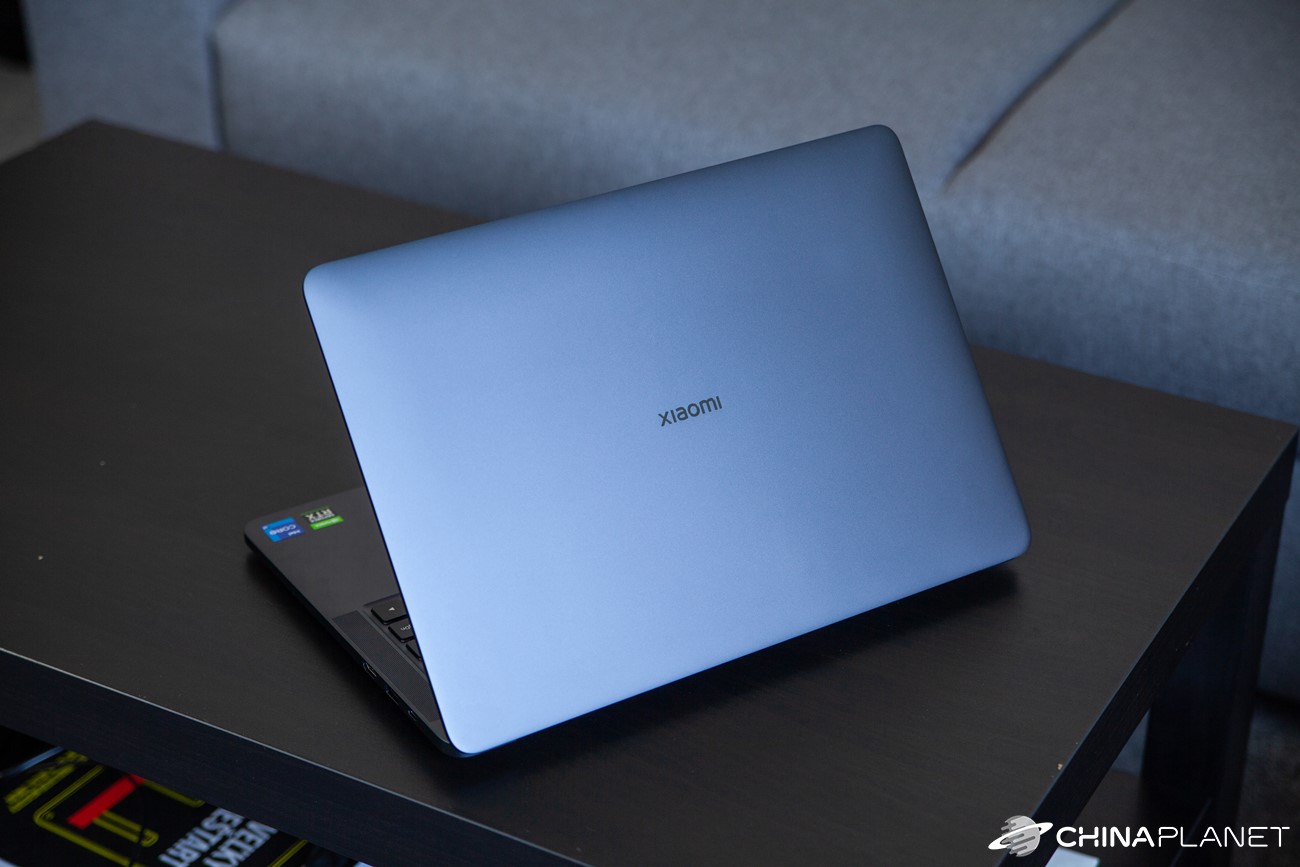
The first impression after unpacking the laptop is excellent. The chassis is made from aluminum using CNC technology, and the entire surface is matte, in dark gray. The design subtly resembles the competition—like the MacBook Pro.
You’ll find the Xiaomi logo on the back as well as under the display, which is framed with glossy black trim. The laptop can be opened with one hand. The hinges are sturdy enough, so they hold the display position perfectly. Maximum opening isn’t quite horizontal, but it’s more than enough for everyday use.
The keyboard is surrounded on both sides by speakers and is completed by a large touchpad. It measures up to 12.5 x 8 cm, so it provides a truly large surface. It responds great to touch and finger movement, and it also clicks pleasantly with a proper, non-annoying feedback.
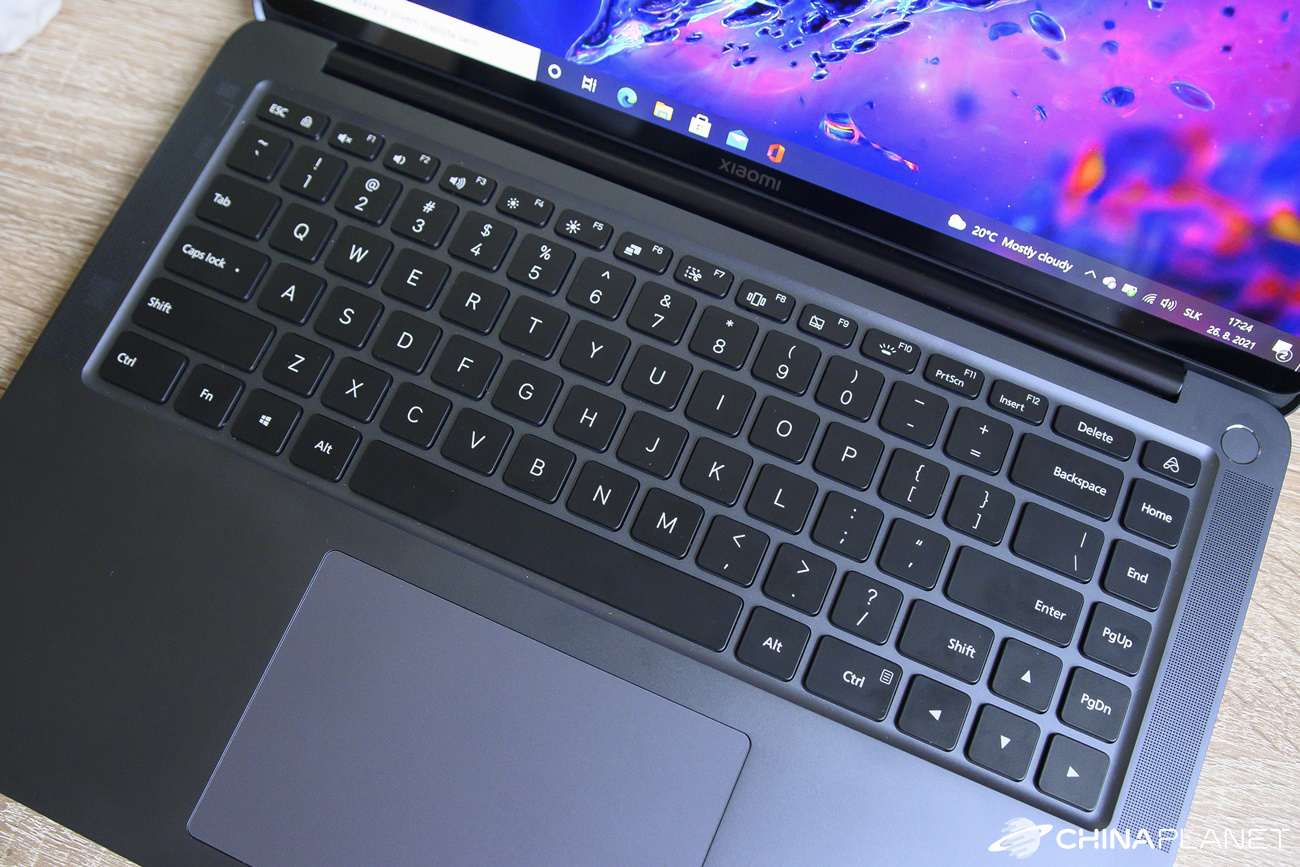
The so-called full-size keyboard is also top-notch. The keys have a matte finish, accidental presses are eliminated thanks to the spacing between the keys, and it’s exceptionally quiet. Backlighting is included too, and you can adjust it in three levels using the corresponding key, including automatic adaptation.
The keyboard itself is also sturdy enough, and even with strong pressing on different spots, it barely flexes. There’s no numeric keypad, but that’s at the expense of size neither for the keyboard nor for the laptop.

The power button has an elegant glossy frame and is placed in the top-right corner, away from the keyboard. The button also integrates a fingerprint reader, which works really well. There’s certainly a slight delay—shorter than 1 second—but it’s absolutely not annoying. The reader is very reliable, and it never happened to us that it failed to recognize the fingerprint on the first try.
A beautiful OLED display
Xiaomi Mi Notebook Pro X’s big pride is its 15.6″ OLED display. It has a 16:10 aspect ratio and a 3.5K resolution of 3456 x 2160 px.
This is a Samsung E4 panel with a response time of just 1 ms, a contrast ratio of 1 000 000:1, brightness up to 600 nits, and sharpness of 261 ppi. It covers 91 % of the top area of the laptop, so the bezels around it are very thin.
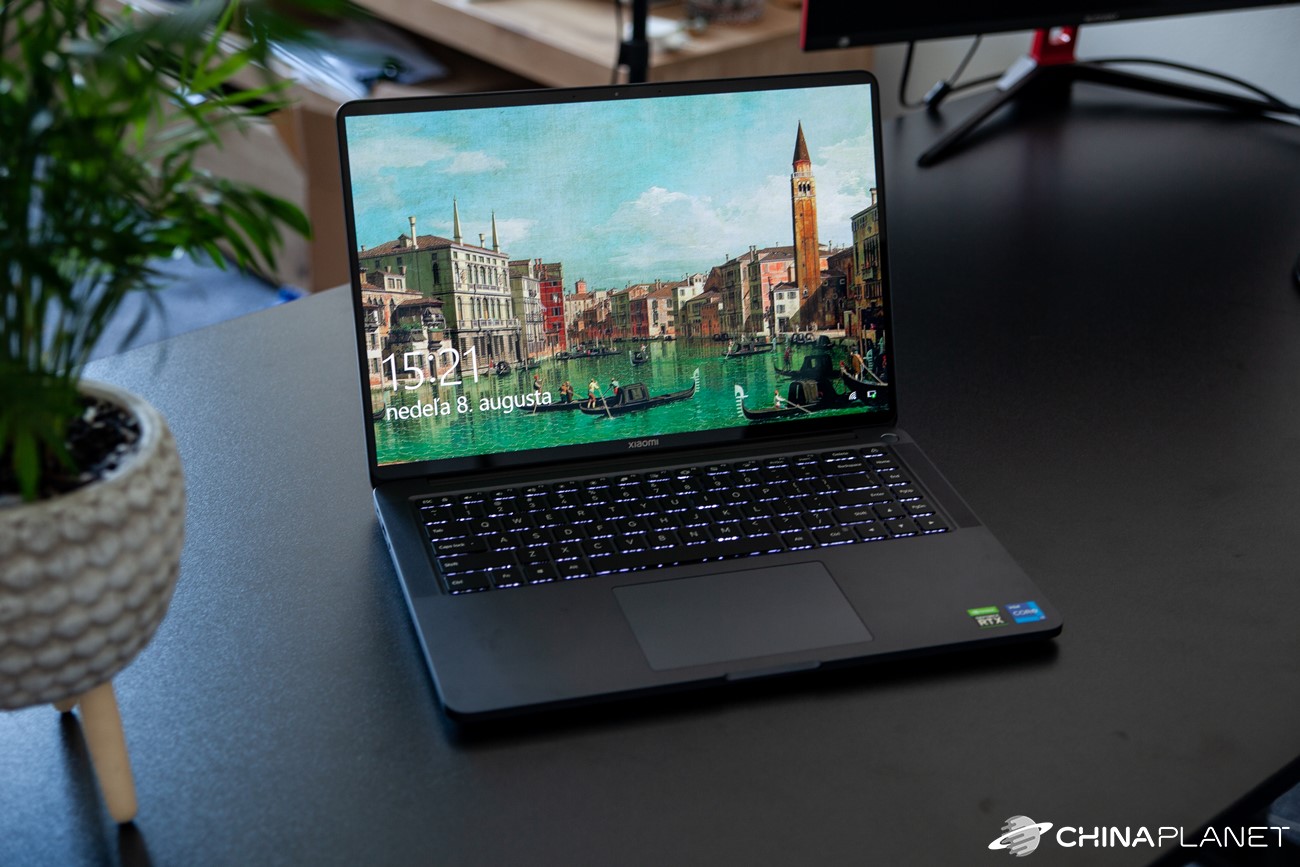
The display received several certifications, such as TÜV Rheinland Hardware Low blue light or True HDR 500 Display, confirming its quality. It covers up to 100 % of the DCI-P3 color gamut, which offers a range that’s about 25 % wider than sRGB.
The display is also, at first glance, a real top-tier option. The colors are beautiful, vivid, and high-contrast, and black is truly black—not dark gray like we’re used to with IPS panels. It’s a pleasure to look at this display, and thanks to its specs, even someone working with graphics or editing photos shouldn’t feel embarrassed by it.

Above the display there’s a webcam that’s very discreet thanks to its compact dimensions. Its resolution, 720p, doesn’t belong to the best, but it’s enough for a regular video call.
Great performance even for demanding games
Performance is handled by the 11th generation Intel i7 processor — Tiger Lake, specifically the Intel Core i7-11370H, manufactured using the 10 nm technology. Its clock speed ranges up to 3.3 GHz, but it doesn’t support the so-called turbo boost, where it could reach a maximum of 4.8 GHz.

It’s a quad-core processor with 8 threads designed for laptops, whose sales were launched in the first quarter of 2021. It has 12 MB of Intel Smart Cache (L3), plus an integrated Intel Iris Xe Graphics chip with a frequency of 1.35 GHz.
Xiaomi Mi Notebook Pro X also features a dedicated gaming graphics card, the NVIDIA GeForce RTX 3050 Ti, with 4 GB of GDDR6 memory, built on the NVIDIA Ampere architecture. The graphics card is suitable for playing the latest titles as well as for video work or 3D graphics. It was introduced to the market in May 2021.

LPDDR4x RAM in our configuration has a capacity of 32 GB with a frequency of 4266 MHz. There’s also a version with 16 GB of RAM, an Intel i5-11300H processor, a 512 GB SSD drive, and the same graphics card.
On the laptop, we tested several games, including PUBG Battlegrounds, which was even free on Steam at the time of writing the review, Counter-Strike: GO, or World of Tanks. All of the titles mentioned ran as expected—smoothly, with no delays or hiccups. The newer PUBG ran at higher settings at 40 – 55 fps, while Counter-Strike and World of Tanks ran at over 100 fps.

We also tested performance using the well-known, freely available benchmark Cinebench R23. You can check the results below.

In our configuration, we received a 1 TB SSD drive, which we tested using the CrystalDiskMark tool. This tool measures sequential and random read and write speeds. The measured speeds were as follows:

Runtime and charging
Xiaomi Mi Notebook Pro X has a 80 Wh battery with support for 130 W charging via a USB-C port. The manufacturer states a maximum battery life on a single charge of up to 11.5 h. However, runtime depends a lot on how you use it and the display brightness level. For standard office work with half brightness, Wi‑Fi enabled, and power set to battery saver mode, the system shows battery life of up to 22 hours, but that’s not really realistic.

After 30 minutes of playing PUBG, the battery capacity dropped from 100 % to 57 %. Our power mode was set to maximum performance. On the other hand, during normal office work—when power mode was set to battery saver with Wi-Fi enabled—after one hour the capacity dropped by only 10 %.
We started the charging test at 15 % battery capacity while writing this review. The laptop had its display turned on continuously during charging. The progress was as follows:
- 50 % in 20 minutes
- 75 % in 37 minutes
- 90 % in 55 minutes
- 100 % in 1h 25 minutes
Charging a closed laptop without using it takes only a few minutes less—it’s not a significant difference.
Cooling, noise
The Xiaomi Mi Notebook Pro X features a so-called hurricane cooling system, which consists of a pair of fans and also two copper heat pipes.
Air is drawn in from the bottom of the laptop, where there are two grilles across the entire area. Warm air is then exhausted to the back, so the user barely notices it, since it isn’t blowing from the side.

During normal work, the cooling isn’t audible at all and the laptop stays completely cool. However, during gaming or other heavy loads, it’s completely different. The fans spin up and you can definitely hear them. The noise level is around 55 dB.
The notebook gets hottest above the keyboard, in the middle section. During gaming, this area is truly very hot to the touch. As for the CPU, GPU, and drive temperatures, we measured them using the CPUID HWMonitor app before and during playing PUBG.


As you can see, the maximum temperature of the CPU cores during gameplay rose to as high as 96 – 98 °C, which is quite a high value.
Sound and connectivity
Just like with Xiaomi flagship smartphones, here we also find speakers from Harman Kardon. This is a pair of 2 W and another pair of 1 W speakers that deliver stereo sound. They’re placed on both sides of the keyboard and they sound pretty good overall. Bass is slightly lacking, but the audio is clear and the maximum volume is high enough.

Wireless connectivity doesn’t miss out on Bluetooth 5.2 and Wi‑Fi 6. Supported standards are 802.11 and / b / g / n / ac / ax. With a connection speed of 1 Gbit/s, we downloaded the World of Tanks game via Wi‑Fi with a size of 29 GB in 10 minutes, or PUBG with a size of 38 GB in 14 minutes.

As we mentioned in the intro, the notebook has the following ports: HDMI 2.1, 2x USB-A gen 3.2, Thunderbolt 4, USB-C, and a 3.5 mm audio jack. You’ll especially appreciate the Thunderbolt 4, with which you can even connect a 4K monitor with a refresh rate of 60 Hz to the notebook. It supports dual 4K video output or one 8K.
Final verdict
Xiaomi Mi Notebook Pro X 15 is a great notebook for versatile use. It’s suitable not only for everyday work, but also for gaming, video editing, or creating graphics. It delivers massive performance thanks to an Intel Core i7-11370H processor with a maximum frequency of up to 4.8 GHz, 32 GB RAM, a 1 TB SSD, and a dedicated GeForce RTX 3050 Ti graphics card with 4 GB GDDR6.

You’ll also like the gorgeous OLED display with 3.5K resolution and excellent color reproduction, the aluminum build, and overall a well-executed design. A smaller downside is weaker cooling under higher load, when the CPU core temperatures reach high levels.
Don’t miss the best coupons 📩
Subscribe and we’ll email you new coupons before they expire. We only send it once a month — no spam.


