


Robotic pool vacuum has become a standard piece of garden equipment after the last two seasons—from an expensive toy to something people buy as a routine. The brand Seauto is one of the ones driving this change: they offer robots from about one hundred and sixty euros up to almost three hundred, and all of them promise cleaning the floor, walls, and the waterline. So the question isn’t whether to buy such a robot, but which one: with Seauto, the choice usually comes down to Seauto SAT 40 vs SAT 20 Pro, or the cheaper SAT20, or the Crab.
We put four models side by side: the flagship Seauto SAT 40, the Seauto Crab 2026 version, Seauto SAT 20 Pro, and the most affordable Seauto SAT20. Right at the start, one important note—this is where you can really get burned: SAT20 and SAT 20 Pro are not the same robot. They’re sold under one lineup as two variants, but the plain SAT20 runs on four wheels, while the Pro has tracks—and that’s a crucial difference when climbing walls. The specs in the table below are taken directly from the manufacturer’s official pages, not from sales listings.
Seauto SAT 40 vs Crab vs SAT 20 Pro vs SAT20 comparison
The table is based on Seauto’s official spec sheets. SAT20 is the only one from this quartet that doesn’t have its own product page on the manufacturer’s website, so its data comes from the seller’s listing on AliExpress — in rows where the value isn’t provided, we’ve left the field blank rather than guessing.
| Seauto SAT 40 | Seauto Crab | Seauto SAT 20 Pro | Seauto SAT20 | |
|---|---|---|---|---|
| Ideal pool area | up to 3200 sq ft (approx. 300 m²) | up to 2150 sq ft (200 m²) | up to 2150 sq ft (200 m²) | up to 200 m² |
| Pool type | above-ground and in-ground | in-ground | in-ground | above-ground and in-ground |
| Water depth | max. 4 m | 0.5 to 5 m | 0.5 to 5 m | 0.5 to 5 m |
| Supported water pH | not specified | 7.0 to 7.8 | 7.0 to 7.8 | not specified |
| Drive type | track-based AWD / 4 brushless motors | track-based / 2 drive + 1 pump | track-based 4WD / 2 drive + 1 pump | 4×4 wheels / brushless motor |
| Motor power | 320 W according to the seller’s listing | 180 W | 180 W | not specified |
| Suction and flow | 120 GPM according to the seller’s listing | 80 GPM (17 to 20 m³/h) | 80 GPM (17 to 20 m³/h) | 18 000 Pa / 4800 GPH |
| Movement speed | 18 m/min | 18 m/min | 12 to 24 m/min | not specified |
| Brushes | Front high-speed + rear standard | Pair of PVC rollers in the front and at the back | Front high-speed | Pair of rotating |
| Cleaning zones | Bottom / walls / waterline / auto mode | Bottom / walls / waterline | Bottom / walls / waterline | Bottom / walls / waterline |
| Cleaning modes | 5 modes | all-cover and app-based settings | 3 (all-cover / along the walls / along the floor) | 3 (auto / floor / walls) |
| Filtration | 250 μm cartridge + 10 μm ultra-fine filter | 250 μm | 250 μm | 250 to 300 μm |
| Filter basket capacity | 3.7 l according to the seller’s listing | 2.5 l with top filling | 2.5 l | not specified |
| Battery capacity | 10 400 mAh | 7800 mAh | 7800 mAh | 7800 mAh |
| Runtime per charge | up to 240 minutes | 2 to 3 hours | 2 to 3 hours | up to 150 minutes |
| Charging time | 4.5 hours (adapter 65 W) | 3 hours | 3 hours | about 3 hours |
| Battery lifespan | not specified | 500 charging cycles | 500 charging cycles | not specified |
| Replaceable battery | yes | yes | not specified | not specified |
| App and Bluetooth | yes, including firmware updates | yes | not specified | not specified |
| Self-parking | yes | Low battery warning | not specified | yes |
| Water resistance | IPX8 | IP68 | IPX8 | IP68 |
| Dimensions | 469 × 396 × 250 mm | 424.7 × 384 × 250.4 mm | 360 × 330 × 230 mm | not specified |
| Weight | 9 kg | 8.7 kg | 6 kg | approx. 6 kg |
| Manufacturer’s warranty | 1 year | 1 year | 1 year | 1 year |
| Estimated price range | under 300 € | under 300 € | under 200 € – 220 € | under 160 € – 180 € |
Tracks vs wheels: the walls are what it comes down to
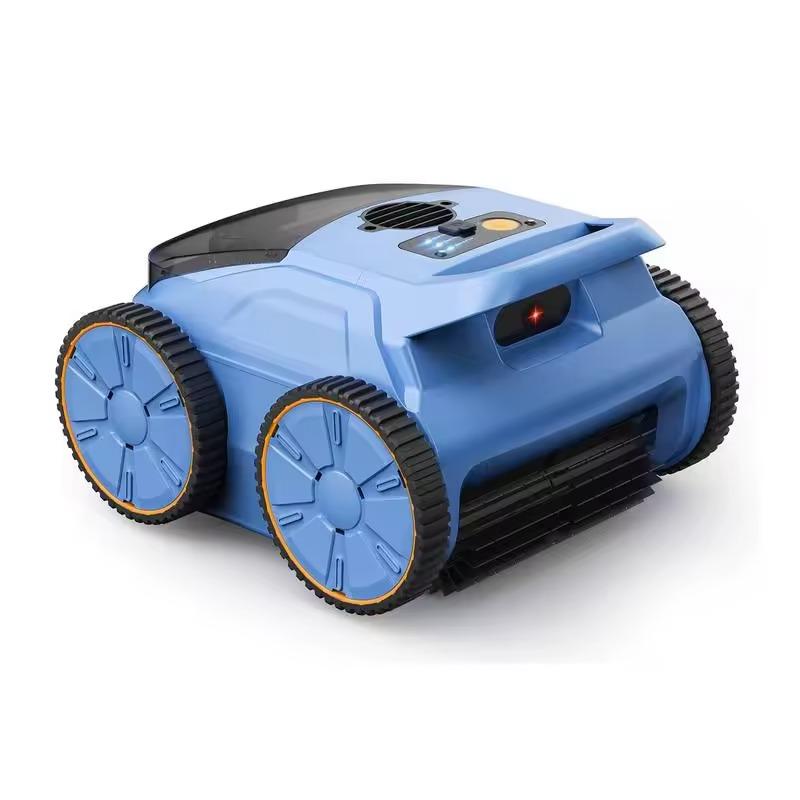
This is the most important difference with pool robots, and most buyers miss it. SAT20, as the only one in this lineup, rides on four wheels with 4×4 drive. On a flat bottom it works great; it can climb the wall too — but with worse traction than we wrote about in a separate article. On smooth ceramic or fiberglass, it performs less well.


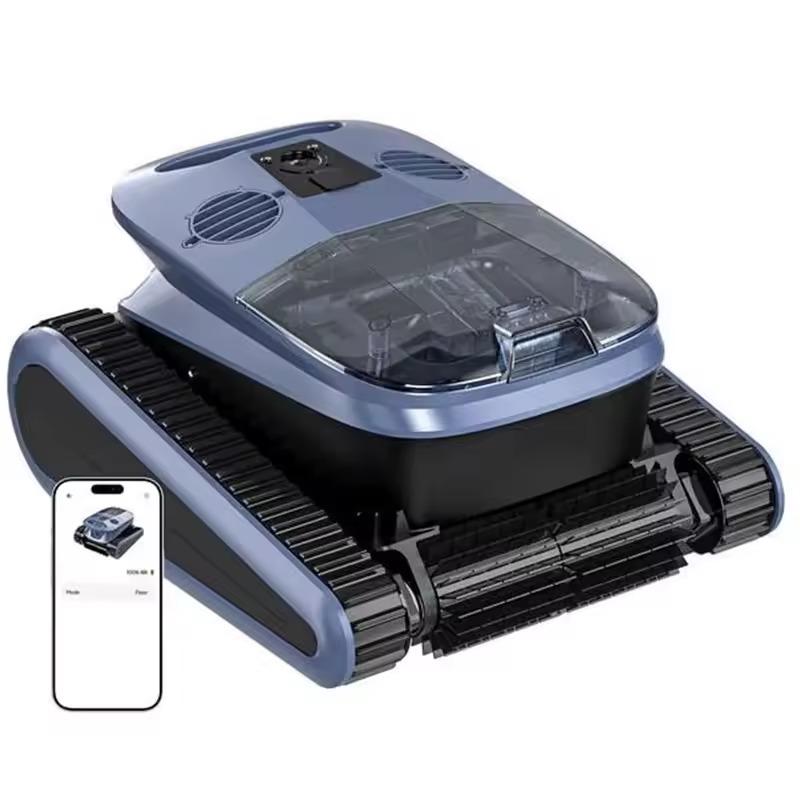
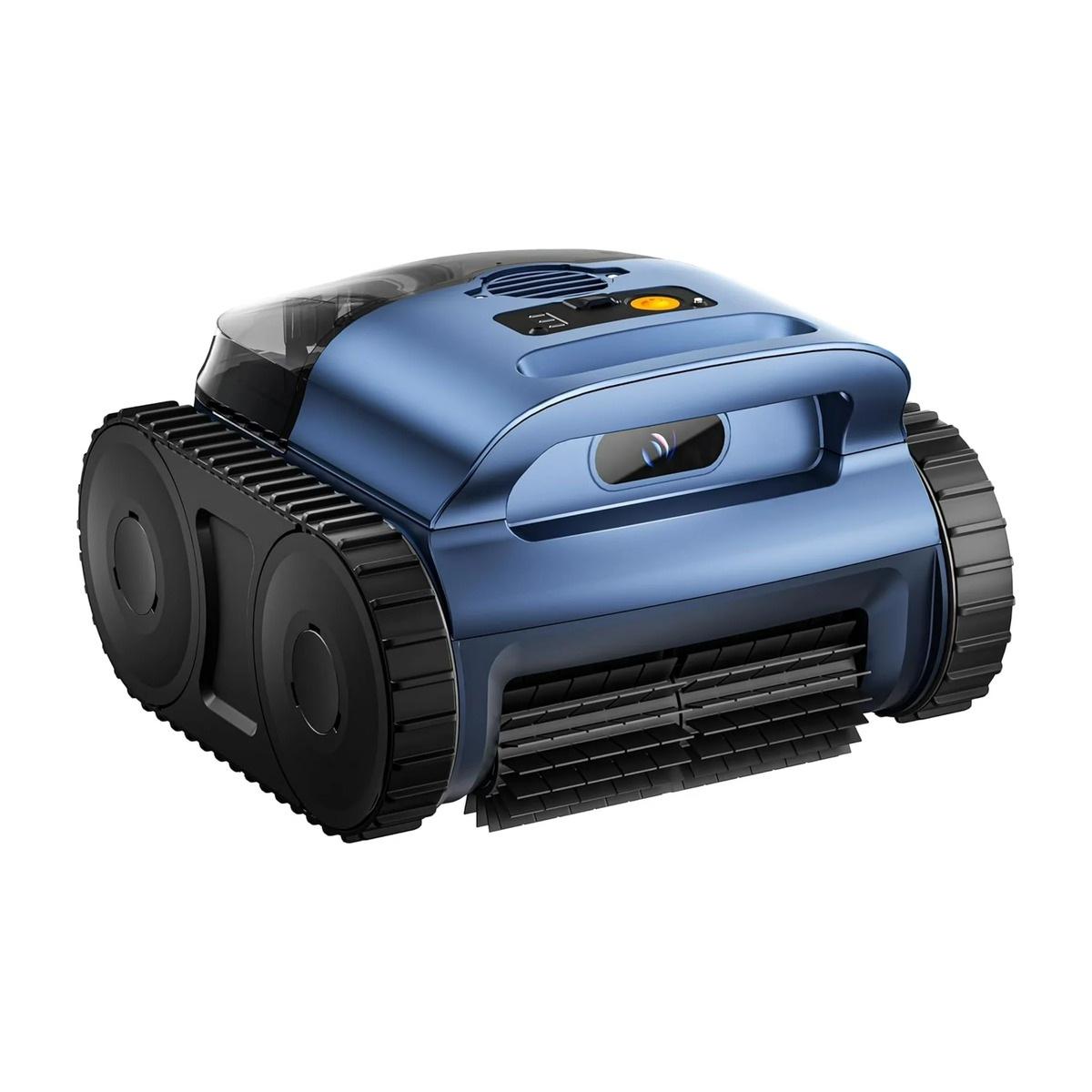
The other three models have a Caterpillar-style track drive. The track spreads the downward pressure over a larger area, so the robot holds better on curved transitions, stairs, and slippery surfaces. And that’s where the biggest surprise in the whole comparison comes in: the SAT 20 Pro also has tracks, and it costs under two hundred euros — it combines them with 4WD traction and three brushless motors, two of which drive the tracks and one that drives the pump. Crab has the exact same motor setup, while SAT 40 goes furthest with four brushless motors and AWD traction, giving it extra headroom when crossing drainage channels and uneven spots on the bottom.
Who wins: on paper, SAT 40, but by price-to-performance, SAT 20 Pro is clearly the better deal. If you have a foil pool with a flat bottom, you won’t feel much difference and SAT20 is enough. If you have ceramic, fiberglass, or a more complex shape with stairs, you’re not buying the tracked model for luxury — you buy it so the robot doesn’t slip. And the cheapest way to get tracks is through the SAT 20 Pro.
Suction power and filtration: the flagship really wins here
Both Crab and SAT 20 Pro have the identical flow — 80 gallons per minute, i.e., 17 to 20 m³ per hour, for both units with a 180 W motor. SAT20 lists a suction vacuum of 18,000 Pa and a flow rate of 4800 GPH — which is essentially the same value expressed differently. SAT 40 does not state the flow rate at all on its official page; the figure of 120 gallons per minute comes from the seller’s listing, so take it with a grain of salt — what is confirmed is only that it has four motors instead of three.


Where the difference is black on white, that’s the filtration. Crab, SAT 20 Pro, and SAT20 all work with a filter fineness of 250 μm, which easily catches leaves, sand, and small stones. SAT 40 adds an ultra-fine filter rated at 10 μm on top of its 250 μm cartridge — that’s a twenty-five-times finer sieve that pulls pollen, fine dust, and even residue from sun lotion out of the water. If you have trees above your pool or you’re dealing with pollen in May, this is the strongest argument in the entire comparison.
Who wins: SAT 40, and not by a little. The remaining trio is practically even in filtration and flow, so other parameters decide.
Battery & runtime: 240 minutes vs 150
Crab, SAT 20 Pro, and SAT20 all have the same 7800 mAh battery. Crab and SAT 20 Pro claim two to three hours of operation and charging in three hours, and for both, the manufacturer promises a lifespan of 500 charging cycles. SAT20 reaches 150 minutes. What’s interesting is that the seller listing for SAT 20 Pro also says 150 minutes, while the official page mentions two to three hours — the truth is somewhere in between and will depend on the selected mode.


SAT 40 plays in a different league — 10,400 mAh and up to 240 minutes of runtime. In four hours, it can thoroughly clean even a recessed pool with an area approaching three hundred square meters. The trade-off is longer charging time, 4.5 hours via a 65W adapter. The good news is that the battery can be replaced on SAT 40 as well as on Crabe, so after a few seasons you won’t need to buy a whole new robot.
Who wins: SAT 40, hands down. For pool robots, battery life matters more than suction power — if the battery runs out halfway through a cycle, the second half of the pool stays dirty no matter how many pascals the robot pulls.
Navigation: sonar is a must-have, but not the same for everyone
A pleasant surprise is that all four models have sonar navigation, including the cheapest one. In this price range, that’s still the exception — competitors in this tier often rely on random movement, where the robot visits some spots five times and others not at all.


The difference is what the robot does with the sonar. SAT 40 has AI route planning and five cleaning modes, including separate surface and automatic modes; when it’s done, it automatically moves to the edge for pickup. SAT 20 Pro promises N-Path pattern movement combined with adaptive terrain mapping and offers three modes — complete, walls only, and floor only. Crab uses SonarNav Pro with route planning and an All-Cover mode that’s fine-tuned via the app. SAT20 also has sonar, but in practice we noticed it sometimes pauses for ten to twenty-five seconds while the sensors evaluate the next direction.
Who wins: SAT 40, especially thanks to the number of modes. However, the difference versus SAT 20 Pro and Crabe is smaller than the gap in battery or filtration.
Wall surfaces, the waterline, and what happens to grease
The waterline is where sunscreen, grease, and pollen settle — and it’s also the area that cheap robots don’t address at all. All four models can clean the floor, walls, and the waterline, which is the main reason it makes sense to go for Seaute at this price.


The difference is in the brushes. SAT 40 has a front high-speed brush plus a standard rear brush, and according to the foreign video review we mentioned in the article about this model, cleaning the surface is one of its strongest disciplines. Crab is the only one with a pair of active PVC rollers in front and rear that can work independently — it’s the best solution of all four for scrubbing. SAT 20 Pro has only the front high-speed brush, while SAT20 has a pair of standard rotating brushes.
Who wins: Crab thanks to the pair of rollers, just narrowly ahead of SAT 40. One detail in the flagship’s disfavor: SAT 40 is certified for depths up to four meters, while Crab and SAT 20 Pro handle five. For a deep pool, that’s a difference worth considering.
Maintenance, weight, and controls
For robots you’ll lift out of the water several times a week, these practical things matter more than you might think. SAT20 and SAT 20 Pro weigh 6 kilograms, Crab 8.7 kg, and SAT 40 a full 9 kg. You’ll feel the three-kilogram difference of the wet robot when you lift it with an outstretched arm over the pool edge — and it’s one of the quiet arguments in favor of SAT 20 Pro, which, despite its weight and dimensions for a budget model, offers the kind of tech you’d expect from more expensive options.


The filter basket is pulled out from the top on all four units, which is the most convenient option. At SAT20, however, we listed the removable lid of the basket as a weakness—it’s not exactly practical. Crab and SAT 20 Pro both have a 2.5-liter basket, while SAT 40 is 3.7 liters according to the seller. The mobile app is only available for SAT 40 and Crab, and SAT 40 can also be updated via Bluetooth, so the manufacturer may add new functions over time. For SAT 20 Pro, the app isn’t mentioned in the specs, even though multiple customers bring it up in reviews.

Who wins: for handling SAT20 and SAT 20 Pro, for controlling and long-term support of SAT 40.
Price and availability
The price gap within this lineup is more interesting than you’d expect. With the coupon, SAT20 goes under 160 EUR, SAT 20 Pro under 200, and SAT 40 and Crab also fit under 270 EUR — so those two are practically price-equivalent. All four are from trusted sellers on AliExpress and ship from a EU warehouse, so delivery is usually a matter of days and without any extra fees. Don’t forget to use coupons from the price boxes too.
Flagship Seauto SAT 40 for pools up to 300 m² with a 10 μm filter:
Seauto SAT 40
 DE warehouse

TIPExpress delivery from a German warehouse without customs duty and VAT.
This product will be delivered express from the local German warehouse. Shipping from Germany usually takes 7-10 days, and the delivery is handled by a courier. When it arrives, you won’t pay any additional fees—no customs duty or VAT.
Seauto SAT 20 Pro — track drive and 80 GPM for under 200 EUR:
Seauto SAT 20 Pro
 DE warehouse
TIPExpress delivery from a German warehouse without customs duty and VAT.
This product will be delivered express from the local German warehouse. Shipping from Germany usually takes 7-10 days, and the delivery is handled by a courier. When it arrives, you won’t pay any additional fees—no customs duty or VAT.
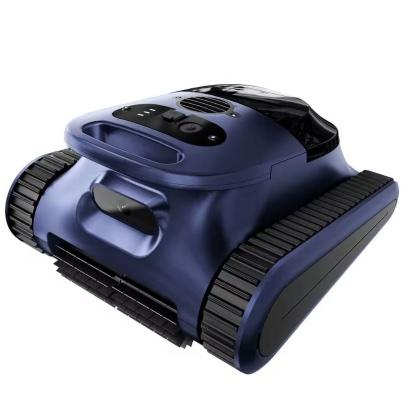
Seauto Crab with a pair of cylindrical brush rollers and a replaceable battery:
Seauto Crab
 DE warehouse
TIPExpress delivery from a German warehouse without customs duty and VAT.
This product will be delivered express from the local German warehouse. Shipping from Germany usually takes 7-10 days, and the delivery is handled by a courier. When it arrives, you won’t pay any additional fees—no customs duty or VAT.
And the most affordable Seauto SAT20 for smaller and liner pools:
Seauto SAT20
 DE warehouse
TIPExpress delivery from a German warehouse without customs duty and VAT.
This product will be delivered express from the local German warehouse. Shipping from Germany usually takes 7-10 days, and the delivery is handled by a courier. When it arrives, you won’t pay any additional fees—no customs duty or VAT.
Final verdict: which one to choose
If you have a built-in pool over 200 m², trees around, or pollen is bothering you, get Seauto SAT 40 and you won’t have to think about it. Four motors, 240 minutes of runtime, five modes, an app with updates, and—most importantly—an ultra-fine 10 μm filter that none of the other three models have. It’s also the only model certified for a 300 m² area. The only thing to watch out for: it’s designed for a depth of four meters, not five.
But if you’re looking at the money, get Seauto SAT 20 Pro. In our view, this is the most sensible choice among the entire lineup. It has literally the same motor system, flow rate, battery, filtration, and charging time as the Crab that costs about seventy euros more, plus a track drive with 4WD traction and a weight of just six kilograms. For a typical home pool up to 200 m², we can’t find a reason to pay extra—unless you need pollen filtration or a four-hour runtime.
Get the Seauto Crab only if the pair of cylindrical brush rollers matters to you. It’s the only model in the lineup with active PVC rollers at the front and back that can work independently—this is the best solution in the test for clogged walls and tough deposits. It also has a mobile app and a replaceable battery. However, you pay about seventy euros more than with SAT 20 Pro and you get a robot that’s 2.7 kilograms heavier, with otherwise identically listed specs.
Do you have a liner or above-ground pool with a flat bottom and you mostly do maintenance cleaning? Seauto SAT20 is a sensible buy. Sonar, wall and waterline cleaning, and 150 minutes of runtime for under one hundred and sixty euros is solid kit—and you’ll save more than a hundred compared with the top pick. Just keep in mind that it climbs a smooth wall worse on its wheels; with lots of leaves you’ll need to run a separate bottom-cleaning mode and empty the basket more often.
And who doesn’t benefit from even one of them? Owners of small above-ground pools up to twenty square meters—especially since they’ll drain them in autumn anyway. There, it’s cheaper and faster to vacuum manually with a pole. The robot only starts paying off from the area where you’d otherwise spend about an hour per week cleaning manually.
Follow the China Planet website, subscribe to our monthly newsletter, and be sure to check out our Facebook page, the China Planet group, and join our Telegram, where we add the best offers and coupons from China every single day.
Don’t miss the best coupons 📩
Subscribe and we’ll email you new coupons before they expire. We only send it once a month — no spam.


