


You know this from steak in a pan: along the edges there’s a gray ring of overcooked meat, in the middle it’s still almost raw, and only between that there’s a thin layer exactly the way you wanted it. It’s not a question of talent. The pan has around 200 °C, heat spreads inside slowly, so the surface is fully cooked long before the center even has time to heat up.
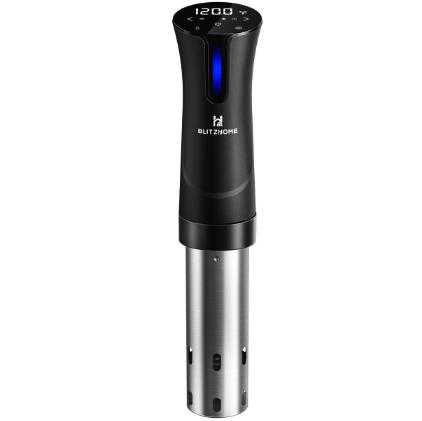
This is exactly what the sous vide method solves, and so does the BlitzHome SV2209. You don’t cook the meat in hot air or on a scorching metal surface, but in water that has the temperature your dish should have from the start. The result is just as evenly cooked from edge to edge, and it won’t heat above the temperature you set.
With a coupon—slightly cheaper
The cooker is currently available on Banggood at a coupon price, and it ships from the Czech warehouse. Courier delivery usually takes 7 – 10 days, and when you receive it, you pay nothing extra—so no customs duty or VAT. On Banggood, it has a 4.8 out of 5 rating from more than 150 customers.
BlitzHome SV2209 Sous Vide
 CZ warehouse

TIPExpress delivery from the Czech warehouse with no customs duties and VAT.
This product will be delivered to you express from the local Czech warehouse. Delivery from Czechia usually takes 7-10 days and is handled by courier. On delivery, you don’t pay any additional fees—no customs duty and no VAT.
How sous vide works and what it actually solves
Sous vide is French for “in vacuum.” You seal food in a bag, remove the air from it, and cook it in water at a precisely set temperature. The trick is that the food never heats up more than the water. If you set 55 °C, the steak will be 55 °C throughout the whole portion—whether you take it out after an hour or an hour and a half. Overcooked edges or a raw center simply don’t happen that way. However, it doesn’t mean you can leave the meat in the water as long as you want—after many hours, the fibers start to break down, and the meat becomes too tender.
The second thing is moisture. In a sealed bag, there’s nowhere for water to go, so the meat won’t dry out like it does in a pan or in the oven. But sous vide also doesn’t create a crust on its own, because that requires a significantly higher temperature. That’s why, after taking the meat out of the water, you pat it dry and sear it on a blazing-hot pan for 30 to 60 seconds on each side. That’s when you get the texture and look you can feel and see on a great steak—and since the inside is already done, the quick sear won’t ruin it.


Approximate temperatures and times
Temperature determines how well the food is cooked through; time determines how tender it is. The table shows commonly used values—especially for meat slices and pieces up to three centimeters thick:
| Food | Water temperature | Time |
|---|---|---|
| Beef steak | 52 °C (rare) | 1 – 2 h |
| 55 °C (medium rare) | 1 – 2 h | |
| 58 °C (medium) | 1 – 2 h | |
| Pork tenderloin | 58 – 60 °C | 1 – 3 h |
| Chicken breast | 63 – 65 °C | 1 – 2 h |
| Salmon | 45 – 50 °C | 30 – 45 min |
| Soft-boiled eggs | 63 °C | 45 – 60 min |
| Carrots and root vegetables | 84 – 85 °C | 45 – 60 min |
Tougher cuts with a lot of collagen—such as pork neck or beef cheek—need a higher temperature and significantly more time. Collagen turns reliably into gelatin at roughly from 60 °C, so these cuts are commonly cooked at 65 to 75 °C for 12 to 24 hours. This is where sous vide makes the most sense: in the oven you’d have to watch a cut like that for hours; here you can just let it work even overnight. If you cook it even longer, the meat loses structure.
What BlitzHome SV2209 can do
It’s an immersion circulator: a unit with a heating element and a propeller that you clip onto the edge of a pot. Thanks to it, the water constantly circulates, so it stays at the same temperature everywhere. The 1 100 W power heats the water fairly quickly, the setting range is 25 to 92.5 °C, and the manufacturer states the temperature control accuracy is ±0.5 °C. The bottom part is made of 304 stainless steel, the device weighs 1.1 kg, and according to the manufacturer it’s quieter than 50 dB during operation.
You set both temperature and time on the touch LED panel on the top side; the color indicator shows which stage the cooking is in. It’s sold in two versions: the standard one and the more expensive with WiFi and a mobile app, where you start and monitor the cooking from your phone. It connects only to a 2.4 GHz network, which isn’t a problem for most home routers, but you should take that into account.
Note about what’s included: According to the official list, the box only contains the sous vide cooker itself. Vacuum bags or the bagging pack for it are not included—you need to purchase them separately. However, it’s not a requirement—food-grade zip bags work too. Just remove the air by slowly immersing the bag in water, then seal it above the waterline. At higher temperatures, i.e. above roughly 70 °C, it’s better to use vacuum bags meant for cooking.
What to watch out for
Sous vide isn’t a way to have dinner on the table in twenty minutes. It’s a method to get consistent results every time, even when you’re not standing over the pot. Before you buy, consider these points:
- You need a fairly large pot: the cooker is designed for a volume of about 10 to 15 liters, and the water level must be between the minimum and maximum marks on the unit.
- The bag must not float: if any part of it rises above the water level, that portion of the food won’t cook. You can clip the bag to the pot wall with a clamp or use a heavier spoon inside the bag.
- During long cooking, the water evaporates: therefore, cover the pot with a lid or foil; otherwise, after a few hours you’ll end up below the minimum water level.
- Hygiene has its own rules: below about 54 °C, meat isn’t pasteurized—so keep 52 °C only for short cooking of a quality cut, and hold multi-hour cooking at 55 °C or higher. Chicken is for 63 °C and above.
- Fish at 45 to 50 °C is basically raw: buy only fresh fish suitable for raw consumption and eat it right away. It’s not suitable for children, pregnant people, or anyone with a weakened immune system.
- You make the crust off to the side: keep in mind that after the water bath comes a pan, grill, or torch—otherwise the meat will look gray.
Who is it for
If you regularly make steaks, duck breast, fish, or tougher cuts of meat and you don’t want to argue about when to pull them out, a sous vide cooker is one of the cheapest ways to get consistently the same results every time. It works just as well for eggs or vegetables, where a few degrees really do matter. If you cook quickly and on the fly, you won’t get much out of it—here, cooking is planned hours in advance.
Follow the China Planet website, subscribe to our monthly newsletter, and be sure to check out our Facebook page, the China Planet group, and join our Telegram, where we add the best offers and coupons from China every single day.
Don’t miss the best coupons 📩
Subscribe and we’ll email you new coupons before they expire. We only send it once a month — no spam.

